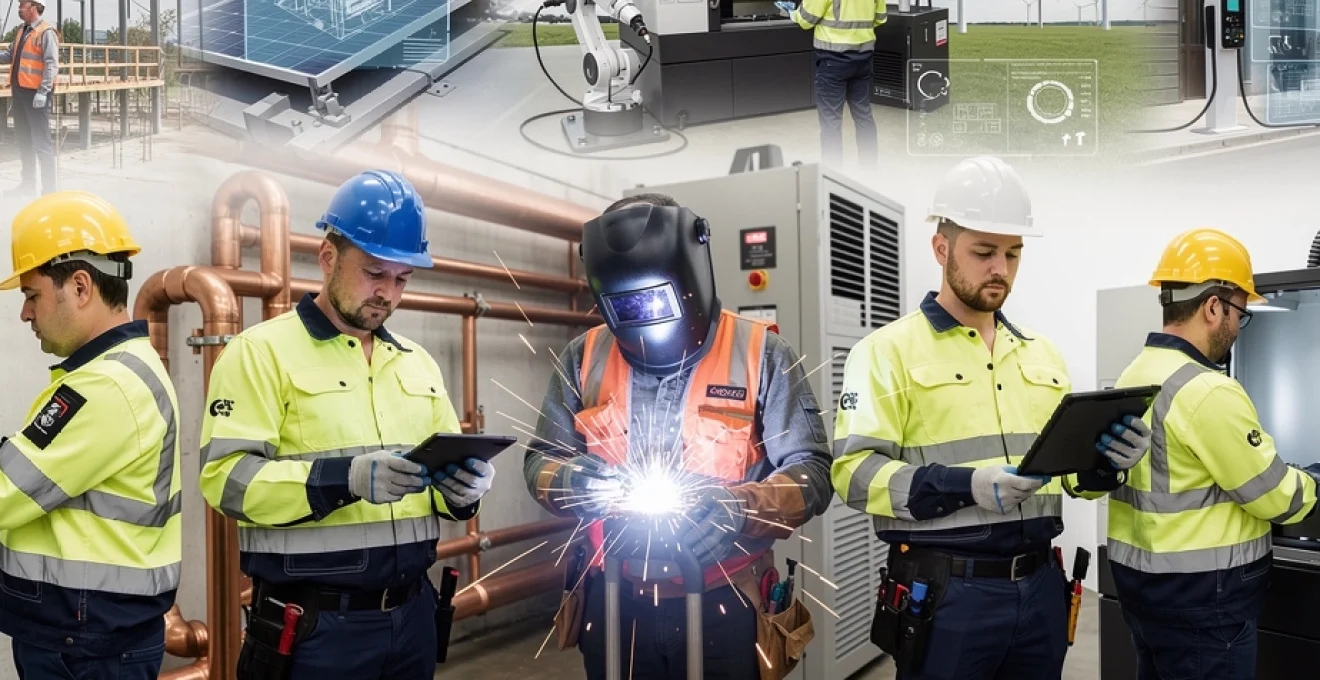
The landscape of skilled trades is undergoing a profound transformation as modern economies grapple with technological advancement, demographic shifts, and evolving industrial requirements. Traditional perceptions of trade careers are being challenged by new realities that position skilled workers as essential drivers of economic stability and innovation. With projected shortfalls exceeding 1.4 million positions across core trades by 2030, representing potential GDP losses of £260 billion annually, the urgency for understanding these changes has never been greater. The convergence of digital technologies with traditional craftsmanship is creating unprecedented opportunities for skilled professionals while simultaneously demanding new competencies that bridge manual expertise with technological proficiency.
Economic transformation of traditional trade classifications in Post-Industrial societies
The International Standard Classification of Occupations (ISCO-08) framework is experiencing significant pressure to adapt as skilled trades evolve beyond traditional boundaries. This classification system, which has historically categorised trades into distinct skill levels, faces challenges in accurately representing the sophisticated nature of modern trade work. Contemporary electricians, for instance, must now possess competencies spanning traditional wiring techniques, renewable energy systems, and smart home technologies—a breadth that transcends conventional skill level categorisations.
Post-industrial societies are witnessing a fundamental shift in how skilled labour is valued and perceived. The traditional hierarchy that positioned university graduates above trade professionals is being challenged by market realities. Skilled tradespeople are increasingly commanding salaries that rival or exceed those of many graduate professionals, particularly in sectors experiencing acute shortages. This economic rebalancing reflects the critical nature of trade work in maintaining essential infrastructure and supporting technological advancement.
Reclassification of ISCO-08 skill categories for electrical and plumbing occupations
Electrical occupations exemplify the complexity of modern trade reclassification challenges. Today’s electrical professionals must integrate traditional installation techniques with advanced systems including photovoltaic arrays, energy storage solutions, and building automation networks. The ISCO-08 framework’s original conception of electrical work as primarily manual labour fails to capture these expanded responsibilities. Modern electrical technicians often perform diagnostic work using sophisticated testing equipment, programme complex control systems, and interpret detailed technical documentation that rivals engineering specifications.
Plumbing occupations face similar reclassification pressures as the industry embraces smart water management systems, sustainable heating solutions, and precision measurement technologies. Contemporary plumbers must understand hydraulic principles, water chemistry, and increasingly complex regulatory requirements governing water efficiency and environmental protection. These expanded competencies suggest a need for elevated classification levels that better reflect the intellectual and technical demands of modern plumbing work.
Digital integration requirements for CITB-Certified construction professionals
The Construction Industry Training Board (CITB) certification framework is adapting to incorporate digital competencies that have become essential for modern construction professionals. Digital literacy requirements now extend beyond basic computer skills to encompass specialised software applications, mobile technology integration, and data management capabilities. Construction professionals must demonstrate proficiency in project management platforms, digital measurement tools, and compliance documentation systems that streamline workflow efficiency and regulatory adherence.
These digital integration requirements are transforming traditional apprenticeship models and continuing professional development pathways. CITB-certified professionals increasingly participate in hybrid learning environments that combine hands-on practical experience with digital simulation and virtual reality training modules. This evolution reflects the industry’s recognition that digital fluency has become as fundamental as traditional craft skills in ensuring competitive advantage and operational effectiveness.
Brexit impact on european recognition of NVQ level 3 qualifications
The United Kingdom’s departure from the European Union has created significant complexities regarding the recognition of National Vocational Qualification (NVQ) Level 3 credentials across European markets. Previously, mutual recognition agreements facilitated the movement of skilled tradespeople between UK and EU jurisdictions, creating fluid labour markets that benefited both employers and workers. The post-Brexit landscape requires new bilateral agreements and recognition frameworks that may not provide the same level of mobility and opportunity.
These changes have prompted UK training providers to develop enhanced qualification pathways that incorporate international standards and competency frameworks. The emphasis has shifted towards creating credentials that demonstrate measurable skills and knowledge rather than relying solely on institutional recognition. This transformation may ultimately strengthen UK trade qualifications by encouraging more rigorous assessment methods and internationally recognised competency standards.
Automation-resistant trade sectors: welding, HVAC, and precision machining
While many routine tasks are increasingly automated, certain skilled trades remain structurally resistant to full automation. Welding, HVAC, and precision machining require a combination of spatial awareness, adaptive decision-making, and context-specific problem-solving that current robotics cannot fully replicate. In welding, for example, variability in materials, joint access, and site conditions still demands human judgement, particularly in high-specification sectors such as aerospace, shipbuilding, and critical infrastructure.
HVAC technicians work within complex, often crowded building environments where legacy systems, bespoke installations, and unpredictable faults are the norm. Automated diagnostics can assist, but they cannot yet replace the nuanced evaluation and customer interaction that on-site professionals provide. Similarly, precision machinists increasingly collaborate with CNC systems rather than compete with them, using their expertise to optimise toolpaths, adjust tolerances, and troubleshoot unexpected vibration or tool wear.
These automation-resistant trade sectors are emerging as strategic pillars in modern economies that seek resilience and flexibility. As data from multiple labour market analyses indicates, demand for welders, HVAC technicians, and precision machinists remains strong even during economic downturns, due to their central role in maintenance, retrofitting, and infrastructure upgrades. For policymakers and employers, prioritising these trades means safeguarding capabilities that underpin advanced manufacturing, energy transition programmes, and national security assets.
Skills gap analysis in critical infrastructure sectors
Critical infrastructure sectors—including energy, transport, water, and telecommunications—are experiencing pronounced skills gaps at precisely the moment when investment in renewal and expansion is accelerating. Reports projecting more than 1.4 million unfilled skilled trade positions by 2030 highlight that the shortfall is not evenly distributed; it is especially acute in roles that demand both advanced technical knowledge and regulatory compliance expertise. This mismatch between labour supply and demand risks project delays, cost overruns, and compromised resilience in essential services.
One of the central challenges in skills gap analysis is capturing the pace at which competency requirements are changing. Job profiles for technicians in power distribution, rail signalling, or water treatment now include digital diagnostics, cybersecurity awareness, and familiarity with environmental standards. Traditional workforce planning models, based on historic replacement rates, underestimate the scale of retraining and upskilling needed to meet these evolving expectations.
For employers and industry bodies, robust skills gap analysis is no longer a purely academic exercise; it is a strategic necessity. By leveraging labour market intelligence, employer surveys, and professional registration data, stakeholders can identify bottlenecks early and design targeted interventions. The objective is not simply to fill vacancies but to cultivate a workforce capable of supporting complex, interconnected infrastructure systems that define post-industrial economies.
Shortage metrics for institute of mechanical engineers registered technicians
Technicians registered with professional bodies such as the Institute of Mechanical Engineers (IMechE) offer a useful barometer of high-value technical capacity in critical infrastructure. Registration as an EngTech or similar grade typically signals adherence to recognised competence standards, ongoing professional development, and a commitment to ethical practice. Yet in many regions, the number of IMechE-registered technicians is not keeping pace with planned infrastructure investments in power generation, rail, and advanced manufacturing.
Shortage metrics derived from membership data, vacancy rates, and salary trends point to mounting pressure. Vacancy durations for mechanical technician roles are lengthening, while employers increasingly report difficulties in securing candidates with both mechanical fundamentals and digital skills such as PLC fault-finding or condition monitoring system interpretation. This divergence between required and available skills can be likened to widening gauge on a railway track: without realignment, the system cannot run smoothly.
Addressing shortages among IMechE-registered technicians requires coordinated action across education providers, employers, and professional institutions. Encouraging earlier engagement with professional registration during apprenticeships, providing supported pathways from Level 3 qualifications to EngTech status, and recognising mentoring activities as part of CPD can all increase the appeal of these roles. For individuals, registration offers a clear route to career progression; for employers, it provides a measurable benchmark for competence in safety-critical environments.
Renewable energy installation workforce: city & guilds solar PV certification demands
The rapid expansion of renewable energy capacity has created surging demand for technicians qualified in solar photovoltaic (PV) installation and maintenance. Certifications such as City & Guilds Solar PV awards have become de facto entry standards for professionals working on domestic, commercial, and utility-scale systems. As governments set ambitious decarbonisation targets, the number of accredited installers required to meet installation schedules is increasing far faster than traditional training pipelines were designed to support.
Solar PV work exemplifies the convergence of electrical trade skills with energy system engineering. Technicians must understand DC and AC systems, inverter technologies, grid connection standards, and increasingly, battery integration and smart metering. Without adequate numbers of City & Guilds-certified professionals, projects risk bottlenecks in commissioning timelines, and consumers face longer waits for installation and repair services. This is already visible in some regions, where waiting lists for qualified installers extend several months.
To close this gap, training providers are developing accelerated pathways that blend online theoretical modules with intensive, hands-on practical assessment. Employers can play a decisive role by sponsoring candidates through Solar PV certification, offering supervised on-site experience, and aligning internal competence frameworks with recognised qualifications. For individuals considering a transition from general electrical work, Solar PV represents a future-proofed niche where skills are transferable across residential, commercial, and decentralised energy projects.
Net zero building standards and advanced insulation techniques training
Net zero building standards are reshaping expectations for construction and retrofit projects, with implications that extend well beyond design professionals. Tradespeople working in insulation, carpentry, and building services must now deliver airtightness, thermal continuity, and moisture control to standards far higher than those historically required. Advanced insulation techniques—ranging from external wall systems to airtight membranes and thermal bridge detailing—demand precise workmanship and a solid grasp of building physics fundamentals.
Without targeted training, even experienced tradespeople may find the transition to net zero standards challenging. Small deviations in installation quality can erode performance gains, much like minor leaks can undermine the efficiency of an otherwise well-designed plumbing system. To avoid this, vocational programmes are embedding modules on thermal imaging, blower door testing, and the interaction between insulation, ventilation, and indoor air quality.
As building codes tighten, professionals who can demonstrate competence in advanced insulation techniques will be highly sought after. Training aligned with recognised frameworks—such as passive house principles or national retrofit programmes—gives tradespeople a competitive edge and reassures clients that performance targets can be met in practice, not just on paper. For policy-makers, investing in this form of training is essential if net zero commitments are to translate into measurable reductions in operational energy use.
Electric vehicle charging infrastructure: IMI-accredited automotive electrician requirements
The electrification of transport is creating new demand for automotive electricians with specialist competencies in high-voltage systems and charging infrastructure. Accreditation from bodies such as the Institute of the Motor Industry (IMI) has become a key marker of readiness to work safely on electric vehicles (EVs) and associated charging equipment. These credentials typically cover high-voltage isolation procedures, battery management systems, and diagnostics for power electronics—skills far beyond those required for traditional internal combustion engine maintenance.
EV charging infrastructure itself straddles automotive and electrical installation domains. Technicians must coordinate with distribution network operators, understand load management strategies, and ensure that installations comply with evolving safety standards. As cities and businesses accelerate roll-outs of public and workplace chargers, shortages of IMI-accredited professionals could slow deployment and limit public confidence in the reliability of charging networks.
For technicians contemplating upskilling, IMI-accredited EV qualifications offer access to a rapidly expanding market that spans domestic, commercial, and fleet applications. Employers can support this transition by providing structured learning time, covering course fees, and integrating EV competencies into job roles and pay frameworks. From an economic standpoint, ensuring a robust pipeline of accredited automotive electricians is essential to supporting cleaner transport systems and realising the full benefits of EV adoption.
Compensation benchmarking against graduate professional salaries
One of the most striking developments in modern labour markets is the narrowing, and in some cases reversal, of historical pay gaps between skilled trades and graduate professions. In regions experiencing acute shortages, it is increasingly common for experienced electricians, plumbers, and HVAC technicians to earn total compensation packages that match or exceed those of early-career graduates in fields such as business administration or the humanities. This shift is reshaping career decision-making for young people and their families.
Compensation benchmarking reveals that total reward in the skilled trades extends beyond base pay. Overtime opportunities, productivity bonuses, travel allowances, and employer-sponsored training can substantially increase overall earnings. In addition, many tradespeople have pathways to self-employment or small business ownership, where income potential is closely tied to local demand and reputation. When viewed over a ten-year horizon, lifetime earnings in certain trades compare favourably with those of many office-based roles that require significant student debt.
For employers, competitive compensation is no longer optional if they wish to attract and retain high-calibre tradespeople in a tight labour market. Transparent pay frameworks, linked to clearly defined skill levels and certifications, help signal that trade careers offer structured progression akin to professional career ladders. This reframing can help counter outdated perceptions that skilled trades are a “second choice” for those who do not pursue university, positioning them instead as strategic, well-rewarded options in a modern economy.
Technology integration in traditional craftsmanship methodologies
The integration of digital tools into traditional craftsmanship is transforming how skilled trades operate, learn, and innovate. Rather than replacing manual expertise, technologies such as CAD-CAM, Building Information Modelling (BIM), and Internet of Things (IoT) platforms act as force multipliers, enabling tradespeople to deliver greater precision, efficiency, and reliability. The key challenge is ensuring that these tools complement, rather than overshadow, the tacit knowledge that underpins high-quality workmanship.
We can think of this integration as fitting a modern engine into a classic vehicle: the aesthetics and core structure may remain familiar, but performance, reliability, and diagnostics capabilities improve dramatically. Carpenters now use digital laser measurements to complement traditional layout techniques; welders reference digital welding procedure specifications; and building services engineers rely on cloud-based documentation to manage maintenance histories. The tradesperson’s toolkit has expanded from physical instruments to include laptops, tablets, and augmented reality headsets.
For individuals already established in their trades, embracing technology is less about abandoning old methods and more about adding new layers of capability. Those who combine traditional craftsmanship with digital proficiency are better placed to lead teams, liaise with design professionals, and move into supervisory or consultancy roles. For employers, structured digital skills training ensures that investment in technology translates into tangible gains in productivity and quality.
CAD-CAM programming for CNC machining and precision engineering
In precision engineering and machining, CAD-CAM programming has become a central competency rather than a specialist niche. Computer-aided design (CAD) software enables detailed component modelling, while computer-aided manufacturing (CAM) platforms translate these designs into machine-readable toolpaths for CNC equipment. Skilled machinists are increasingly expected to navigate both environments, understanding how design decisions impact cutting strategies, cycle times, and surface finish.
The shift from manual programming at the machine console to integrated CAD-CAM workflows has altered the skill profile of the modern machinist. Instead of focusing solely on handwheel adjustments and manual offsets, professionals must interpret complex 3D models, configure post-processors, and simulate machining operations to detect collisions or inefficiencies before any material is cut. This digital front-loading of effort reduces scrap rates and setup times, yielding significant cost savings in high-value manufacturing.
For aspiring and current machinists, developing CAD-CAM skills opens doors to higher-value roles in process optimisation, prototyping, and design-for-manufacture consultancy. Training providers are responding by embedding CAD-CAM modules into apprenticeship programmes and offering progression routes to advanced diplomas or degree-level study. In practical terms, the machinist who can bridge the gap between design intent and shop-floor execution becomes a critical asset in any precision engineering environment.
Building information modelling (BIM) implementation for construction trades
Building Information Modelling (BIM) is reshaping collaboration across the construction sector, and its implications extend well beyond architects and engineers. Trades such as electrical installation, plumbing, and HVAC now interact directly with federated BIM models to coordinate routes, resolve clashes, and optimise installation sequences. Instead of working solely from 2D drawings, site teams increasingly access 3D models on tablets, enabling them to visualise systems in situ and identify potential issues before they arise on site.
Effective BIM implementation requires tradespeople to develop a baseline level of digital fluency, including navigation of model viewers, understanding of object properties, and familiarity with data fields associated with their systems. While some practitioners initially perceive BIM as an administrative burden, many come to view it as a practical tool that reduces rework and uncertainty. The ability to query dimensions, access equipment schedules, and check clearances directly in the model can save substantial time compared with traditional methods.
Contractors that invest in BIM training for their trade workforce often find that site coordination improves significantly. Clash detection becomes more than a design-stage exercise; it evolves into an ongoing collaborative process, with feedback flowing from site to design teams. For individual tradespeople, BIM literacy enhances employability, particularly on large public or commercial projects where digital delivery is mandated.
Iot sensor integration in smart building maintenance protocols
The rise of smart buildings has brought IoT sensor networks to the forefront of facilities management and maintenance strategies. Sensors monitor everything from temperature and humidity to vibration, occupancy, and energy consumption, generating continuous data streams that inform predictive maintenance regimes. For electricians, building services engineers, and HVAC technicians, integrating and interpreting these sensors is becoming a core part of their role.
Instead of responding only when equipment fails, maintenance teams now use analytics platforms to identify deviations from normal operating parameters, scheduling interventions before breakdowns occur. This shift from reactive to predictive maintenance can be compared to servicing a vehicle based on live engine diagnostics rather than fixed mileage intervals. It requires tradespeople to understand both the physical systems and the data they produce, as well as the communication protocols that connect sensors, controllers, and cloud platforms.
Training in IoT integration for tradespeople typically covers sensor installation standards, network basics, and the use of dashboards and mobile applications to access building performance data. As more assets become connected, professionals who can bridge the gap between physical infrastructure and digital monitoring will be at a distinct advantage. For building owners and operators, equipping maintenance teams with these skills leads to reduced downtime, lower lifecycle costs, and improved occupant comfort.
Augmented reality applications for complex assembly and repair procedures
Augmented reality (AR) technologies are moving from experimental pilots to practical tools on construction sites, factory floors, and maintenance environments. By overlaying digital information onto the physical workspace via tablets, headsets, or smart glasses, AR can guide tradespeople through complex assembly and repair procedures step by step. This is particularly valuable where equipment documentation is extensive or where components are located in difficult-to-access areas.
In practice, AR can display exploded views of assemblies, highlight the exact fasteners to remove, or indicate torque settings in real time. For less-experienced technicians, this reduces reliance on memory and accelerates competence development, while experienced professionals can use AR to verify procedures for unfamiliar models or bespoke installations. The effect is similar to having an expert supervisor available at all times, without the associated labour cost.
Adopting AR does, however, require thoughtful integration into existing workflows. Tradespeople need training not only on the devices themselves but also on how to balance digital guidance with situational awareness and safety. Employers that invest in AR platforms should also ensure that content is kept up to date and aligned with manufacturer guidance. When implemented well, AR can significantly reduce error rates, shorten training times, and enhance confidence in executing high-stakes tasks.
Educational pathway modernisation and industry 4.0 alignment
As Industry 4.0 reshapes manufacturing, construction, and building services, educational pathways for skilled trades must evolve to remain relevant. Traditional apprenticeships focused almost exclusively on hands-on tasks and analogue tools; modern programmes must blend these foundations with digital literacy, systems thinking, and data awareness. The goal is to produce technicians who are comfortable working at the intersection of physical equipment and digital control systems.
Many vocational education providers are redesigning curricula to incorporate modules on automation, robotics, additive manufacturing, and cyber-physical systems. Work-based learning remains central, but is now supported by simulation environments and virtual labs that allow learners to experiment with scenarios that would be too costly or risky to replicate in the real world. This hybrid approach mirrors the realities of contemporary work, where digital commissioning, remote diagnostics, and on-site interventions coexist.
For individuals considering trade careers, modernised pathways offer clearer progression routes and opportunities to specialise in high-value niches such as robotics maintenance, smart grid operations, or advanced building commissioning. For employers, engaging with curriculum design through advisory boards or placement partnerships helps ensure that graduates arrive with the competencies needed on day one. Alignment with Industry 4.0 is not an optional enhancement but a prerequisite for maintaining competitiveness in increasingly technology-driven sectors.
Government policy frameworks supporting vocational excellence
Government policy plays a decisive role in shaping the status and attractiveness of skilled trades within modern economies. Policy frameworks that provide stable funding for apprenticeships, incentivise employer-led training, and recognise vocational qualifications as equivalent in stature to academic degrees can significantly elevate the profile of trade careers. Conversely, inconsistent funding or fragmented standards risk undermining confidence among both learners and employers.
Many countries are introducing or expanding initiatives such as apprenticeship levy schemes, tax credits for training investment, and grants for employers who take on apprentices in shortage occupations. These measures acknowledge that the benefits of a highly skilled trade workforce—improved productivity, stronger infrastructure, and higher employment—extend well beyond individual firms. Effective policies also emphasise quality, linking financial support to adherence to recognised standards and robust assessment processes.
In addition, cross-government strategies on industrial policy, net zero commitments, and digital transformation increasingly reference skilled trades as central enablers. Where vocational routes are integrated into these strategic plans, we see stronger coordination between education ministries, industry departments, and regional authorities. For practitioners on the ground, this alignment translates into clearer qualification pathways, more consistent recognition of skills across borders, and enhanced opportunities for lifelong learning that reflect the dynamic nature of modern trade work.