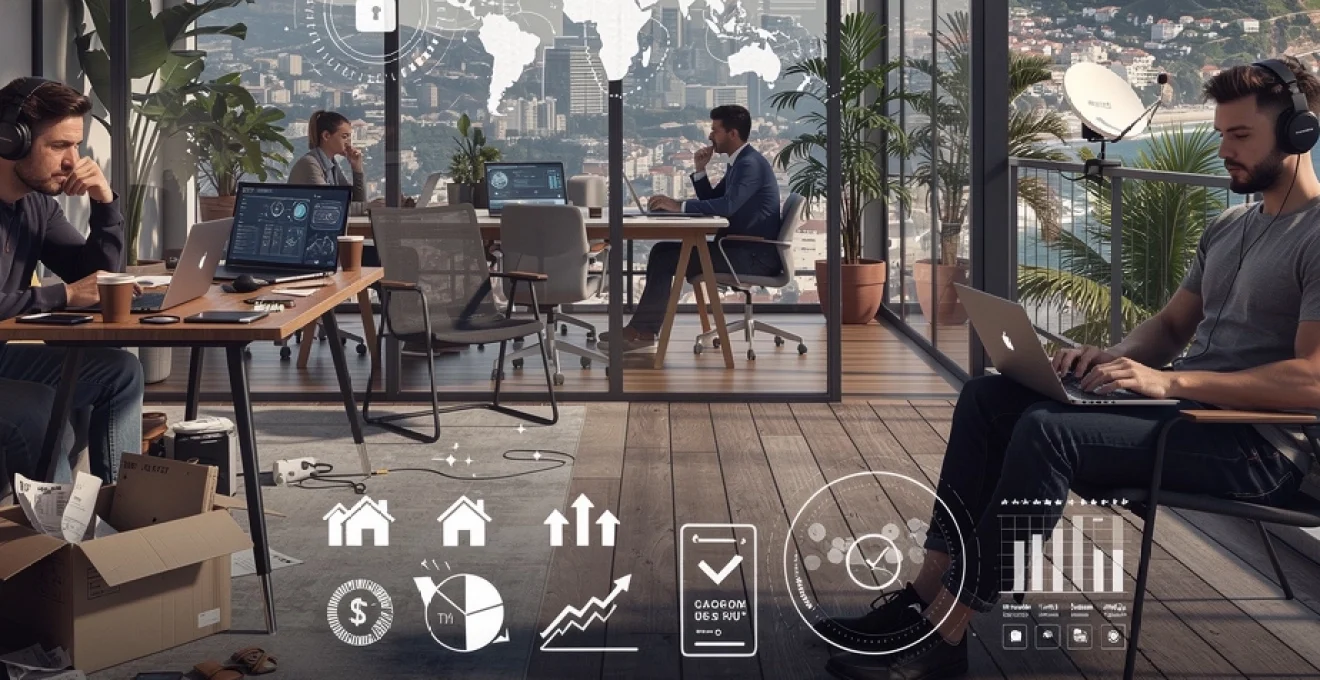
The rise of digital nomadism has fundamentally transformed how we conceptualise work, travel, and economic participation in the 21st century. What began as a niche lifestyle choice for tech-savvy entrepreneurs has evolved into a mainstream movement affecting millions of professionals worldwide. This transformation challenges traditional employment models whilst creating unprecedented opportunities and complex socioeconomic implications.
From Bali’s co-working cafés to Lisbon’s converted industrial spaces, remote workers are reshaping local economies and urban landscapes across the globe. The pandemic accelerated this trend exponentially, with over 35 million people now identifying as digital nomads according to recent surveys. Yet beneath the Instagram-worthy lifestyle lies a complex web of infrastructure requirements, economic disruptions, and sustainability concerns that demand careful examination.
The question facing policymakers, businesses, and individuals alike is whether digital nomadism represents a sustainable evolution of work or a temporary phenomenon with unforeseen consequences. Understanding this movement requires examining the technological foundations that enable it, the economic ripple effects it creates, and the regulatory frameworks attempting to govern it.
Remote work infrastructure requirements for Location-Independent professionals
The foundation of successful digital nomadism rests upon robust technological infrastructure that enables seamless connectivity regardless of geographical location. Modern nomads require reliable internet access, secure communication channels, and sophisticated coordination tools to maintain productivity whilst traversing different time zones and regulatory environments. The infrastructure landscape has evolved dramatically, with new solutions emerging to address the unique challenges faced by location-independent professionals.
Satellite internet solutions: starlink vs traditional broadband in remote destinations
Satellite internet technology has revolutionised connectivity options for digital nomads venturing beyond urban centres. Starlink’s constellation of low-Earth orbit satellites now provides high-speed internet access in previously unreachable locations, fundamentally changing the geography of remote work possibilities. Traditional broadband infrastructure remains superior in terms of latency and cost-effectiveness in established destinations, but satellite solutions offer unprecedented flexibility for nomads seeking truly remote experiences.
The performance metrics reveal significant advantages for satellite solutions in specific scenarios. Starlink delivers download speeds averaging 100-200 Mbps with latency around 20-40ms, making it viable for video conferencing and real-time collaboration. However, traditional fibre connections in nomad hubs like Lisbon or Tallinn offer speeds exceeding 500 Mbps with sub-10ms latency at considerably lower monthly costs. Weather dependency and equipment portability present additional considerations for nomads relying on satellite connectivity.
Co-working space networks: WeWork, selina, and regional hub ecosystems
The proliferation of global co-working networks has created a distributed office infrastructure supporting nomadic lifestyles. WeWork’s international presence provides consistent workspace quality across major cities, whilst Selina’s hospitality-focused model combines accommodation with co-working facilities specifically designed for digital nomads. Regional networks like Hubud in Asia or Outsite globally offer more intimate community experiences tailored to long-stay remote workers.
Membership models vary significantly across providers, with implications for nomad budgeting and planning. WeWork’s all-access passes cost approximately £200-400 monthly, providing flexibility across multiple cities but requiring substantial upfront investment. Regional networks often offer more competitive pricing, with monthly memberships ranging from £50-150, though geographical coverage remains limited. Community-driven spaces frequently provide the most authentic local integration opportunities.
VPN technology and cybersecurity protocols for Cross-Border data protection
Cybersecurity concerns intensify dramatically for nomads accessing corporate networks across diverse regulatory jurisdictions and potentially compromised internet infrastructure. Virtual Private Network technology serves as the primary defence mechanism, with enterprise-grade solutions offering advanced features like split tunneling, kill switches, and multi-hop connections. Zero-trust security frameworks are increasingly adopted by companies supporting remote workers, requiring continuous authentication and encrypted communications.
The regulatory landscape surrounding VPN usage varies significantly across nomad destinations, creating compliance challenges for both individuals and employers. Countries like China and Russia heavily restrict VPN access, whilst others mandate data localisation requirements affecting cross-border data flows. Nomads must navigate these complexities whilst maintaining security standards equivalent to traditional office environments, often requiring specialised knowledge and additional technological investments.</p
Regular security audits, password managers, and endpoint protection tools further strengthen this digital perimeter, especially for freelancers who do not benefit from an in-house IT department. Ultimately, you are recreating the security posture of a corporate office across cafés, co-living spaces, and airports worldwide – without compromising on flexibility.
Time zone management tools and asynchronous communication platforms
For many location-independent professionals, connectivity is no longer the main bottleneck; coordination is. Teams now span San Francisco, Berlin, Cape Town, and Bali, making time zone management a daily operational challenge. Rather than relying solely on overlapping working hours, high-performing distributed teams increasingly adopt asynchronous communication as a core principle.
Time zone visualisation tools such as World Time Buddy, Every Time Zone, or integrated Google Calendar features help remote workers schedule meetings without forcing colleagues into late-night or early-morning calls. Many digital nomads also structure their day around “collaboration blocks” aligned with their main client or employer time zone, while reserving the remaining hours for deep, focused work. This approach reduces burnout and meeting overload whilst respecting regional working patterns.
Asynchronous communication platforms like Slack, Microsoft Teams, Notion, and Loom underpin this shift. Instead of expecting instant replies, teams rely on detailed written updates, recorded video explanations, and shared documentation to keep projects moving around the clock. Clear communication norms – such as response-time expectations, tagging conventions, and decision logs – become the glue that holds distributed teams together. When done well, asynchronous workflows turn global dispersion into an advantage, allowing projects to progress almost 24/7 without forcing anyone to be permanently “on call”.
Economic impact analysis of digital nomad communities on destination markets
The economic footprint of digital nomad communities extends far beyond coffee shops and co-working spaces. Remote workers bring foreign income into local economies, often spending significantly more than average residents on housing, dining, and experiences. Yet this injection of capital can function like a tidal wave: it can nourish coastal ecosystems or erode them, depending on how prepared the shoreline is. Understanding gentrification patterns, local inflation, and housing market distortions is essential for policymakers seeking to harness benefits whilst mitigating harm.
Gentrification patterns in lisbon, canggu, and mexico city nomad hubs
Lisbon, Canggu, and Mexico City illustrate how quickly digital nomad hubs can transform once-affordable neighbourhoods into premium lifestyle districts. In Lisbon, the combination of short-term rentals, remote workers, and tourism has dramatically increased demand for centrally located apartments. According to Portuguese housing data, rents in popular areas such as Bairro Alto and Alfama have outpaced local wage growth for years, pushing long-term residents to peripheral suburbs.
In Bali’s Canggu, cafés with fibre internet, yoga studios, and co-living villas now dominate streets that previously hosted local warungs and family homes. While this new economy has created jobs in hospitality, transport, and wellness services, it has also shifted the commercial mix toward foreign-focused businesses with higher price points. Mexico City’s Roma and Condesa neighbourhoods display a similar pattern: a boom in Airbnbs and boutique hostels catering to digital nomads has displaced some local tenants and transformed the cultural fabric.
These gentrification dynamics are not inherently inevitable, but they are predictable when remote worker inflows outpace housing supply and regulation. Municipal authorities face a delicate balancing act: how to encourage entrepreneurial energy and tourism revenue without turning central neighbourhoods into monocultures accessible only to higher-earning foreigners. Tools such as caps on short-term rentals, incentives for long-term leases, and community benefit agreements can help realign outcomes with local priorities.
Local currency inflation effects from remote worker spending power
Digital nomads often practice “geographic arbitrage”: earning in strong currencies while spending in more affordable markets. From the vantage point of a Lisbon café owner or a Medellín restaurant, this is a boon – higher discretionary spending supports business expansion and job creation. However, when large numbers of high-earning remote workers cluster in the same districts, their spending power can distort local price levels.
In practice, this can manifest as a “two-speed” economy. Prices for goods and services favoured by nomads – specialty coffee, yoga classes, imported groceries, ride-hailing, and furnished rentals – rise faster than wages in the local currency. Residents earning in pesos, rupiah, or rand may find themselves priced out of amenities in their own neighbourhoods, even as the wider macroeconomic indicators for tourism and services appear positive.
Central banks and local authorities typically monitor national inflation, but nomad-driven price pressures often emerge at the micro level: specific neighbourhoods, niche service sectors, and seasonal peaks. For example, in Mexican coastal towns and Indonesian surf hubs, anecdotal evidence suggests that restaurant and accommodation prices can rise 10–20% year-on-year in areas popular with foreign remote workers. Policymakers aiming for sustainable digital nomadism increasingly need granular data – by district and sector – to understand when healthy demand is tipping into harmful inflation for locals.
Tourism revenue diversification beyond traditional hospitality sectors
One argument in favour of digital nomadism is that it diversifies tourism revenue beyond the traditional model of short-stay visitors. Whereas conventional tourists may contribute for a few days or weeks, digital nomads often remain for three months or longer, spending on everyday services rather than only on headline attractions. This creates more stable, recurring demand for local businesses.
In many nomad hubs, we see growth in co-working spaces, fitness and wellness services, language schools, creative studios, and specialised professional services such as accountants and immigration lawyers. Rural initiatives – like remote-work retreats in underpopulated Spanish villages or co-living projects in small Balkan towns – demonstrate how long-stay visitors can help revitalise regions that previously depended on seasonal tourism. Such diversification spreads economic benefits geographically and across more sectors.
However, revenue diversification is only a net positive if it includes local participation and ownership. When co-working spaces, hostels, and tour companies are entirely foreign-owned, a significant share of profits may be repatriated rather than reinvested locally. Encouraging partnerships between international operators and local entrepreneurs, offering training for residents to move into higher-value roles, and supporting local digital skills programmes can ensure that digital nomad tourism becomes an engine of inclusive growth rather than a parallel economy.
Housing market distortions in cape town, medellín, and tallinn
Housing markets sit at the centre of the digital nomad debate, particularly in cities that already face structural shortages. Cape Town, Medellín, and Tallinn each offer instructive case studies. In Cape Town, scenic neighbourhoods like Sea Point and Gardens attract remote workers with a favourable exchange rate and strong infrastructure. Yet South Africa’s inequality and limited social housing supply mean that rising short-term rental prices quickly translate into displacement pressures for lower-income residents.
Medellín’s transformation from a conflict-scarred city to a remote work hotspot is often celebrated, but the surge in international demand for apartments in El Poblado and Laureles has pushed rental prices far above local earning capacity. Many landlords now prefer dollar- or euro-based leases, limiting access for Colombian tenants. Tallinn, though smaller, has seen similar effects in its medieval Old Town and tech-oriented districts, where digital nomads compete with local tech workers and students for centrally located flats.
Policy responses vary. Some cities have introduced licensing requirements and caps for short-term rentals, redirecting stock back into the long-term housing market. Others are experimenting with progressive property taxes or incentivising new residential development away from historic centres. For remote workers evaluating potential destinations, understanding these housing dynamics is an ethical consideration: opting for locally owned accommodation, avoiding “ghost hotel” apartment blocks, and supporting initiatives that reinvest in affordable housing are ways to reduce negative impact.
Visa policy evolution and digital nomad legislation framework
As digital nomadism has scaled from fringe to mainstream, immigration and tax frameworks have been forced to catch up. Traditional visa categories – tourist, student, employee, entrepreneur – were never designed for a professional who spends six months coding from Lisbon, three months consulting from Cape Town, and the rest of the year freelancing from Chiang Mai. In response, more than 70 countries have introduced digital nomad or remote work visas, each with its own eligibility criteria, tax implications, and legal grey areas.
Estonia’s e-residency programme and Blockchain-Based identity verification
Estonia pioneered a new governance model with its e-Residency programme, which allows non-residents to establish and manage an EU-based company entirely online. While e-Residency is not itself a visa or right to live in Estonia, it serves as a powerful infrastructure layer for digital nomads and remote entrepreneurs who require a trusted legal and banking environment. Through e-Residency, founders can sign contracts digitally, access EU payment providers, and maintain transparent corporate records.
The backbone of this system is Estonia’s digital ID infrastructure, which leverages blockchain-style technologies and public key cryptography to secure identity verification and document signing. For location-independent professionals, this reduces the friction of company management – no need to fly back for a signature or stand in a government office queue. It is, in effect, a portable back office that travels with you across borders.
Estonia’s experiment raises a broader question: will we see a future in which identity, taxation, and business regulation are increasingly decoupled from physical residence? If more states adopt e-identity and remote company management tools, digital nomads could choose from a marketplace of regulatory systems, much as they currently select banking providers. This has profound implications for competition between jurisdictions and the evolution of global tax norms.
Portugal’s D7 visa compared to barbados welcome stamp initiative
Portugal’s D7 visa and the Barbados Welcome Stamp illustrate two distinct approaches to attracting foreign remote workers. The D7 is a residence visa aimed at individuals with passive or stable income – including remote workers, pensioners, and investors – who wish to live in Portugal. It often serves as a pathway to longer-term residency and, eventually, citizenship, provided applicants meet stay requirements and integration conditions.
In contrast, the Barbados Welcome Stamp is explicitly framed as a one-year remote work visa. It targets professionals earning above a specified threshold, allowing them to reside and work from the island without entering the local labour market. The scheme’s focus is tourism-adjacent: it encourages long-stay visitors who contribute to the hospitality and service economy but are not seeking permanent settlement.
For digital nomads, the choice between these models depends on lifestyle strategy. Those looking to build a long-term base in Europe may prefer Portugal’s D7, accepting more stringent documentation and minimum-stay requirements in exchange for stability and rights. Those seeking a time-limited Caribbean experience may opt for Barbados, valuing simplicity and clear tax delineation. For policymakers, these programmes reveal different priorities: some countries view digital nomads as potential future residents and taxpayers; others see them as an extension of high-value tourism.
Tax residency complexities under OECD base erosion and profit shifting rules
Perhaps the thorniest aspect of digital nomadism is taxation. The OECD’s Base Erosion and Profit Shifting (BEPS) framework was designed to prevent multinational corporations from shifting profits to low-tax jurisdictions. Yet as individuals become increasingly mobile, similar concerns arise: where should a digital nomad pay income tax if they live in three or four countries each year while invoicing clients globally?
Most tax systems determine residency based on physical presence (often the “183-day rule”) or centre of vital interests. However, frequent movers can find themselves in ambiguous territory, potentially triggering tax obligations in multiple countries. Double taxation agreements help, but few were written with hypermobile individuals in mind. Furthermore, running a company incorporated in one jurisdiction, banking in another, and living in a third can create complex reporting obligations under anti-money-laundering and transparency rules.
For location-independent professionals, proactive tax planning is no longer optional; it is a core component of a sustainable digital nomad lifestyle. Consulting cross-border tax specialists, maintaining meticulous records of travel dates and income sources, and understanding how social security contributions interact with residence-based taxes are essential steps. As more countries court remote workers, we are likely to see clearer guidance and tailored tax regimes – but for now, the burden of compliance largely falls on individuals navigating an outdated system.
Environmental sustainability metrics of hypermobile lifestyle patterns
The romanticised image of the digital nomad often includes frequent flights between continents, weekend getaways to neighbouring countries, and a constant pursuit of the next “hot” destination. From an environmental perspective, this hypermobility comes at a cost. Aviation remains one of the fastest-growing sources of greenhouse gas emissions, and a single long-haul flight can eclipse the annual carbon footprint of a person living in a low-income country.
When we consider the sustainability of digital nomadism, we must look beyond individual freedom and examine aggregate impact. If tens of millions of professionals adopt lifestyles that involve multiple intercontinental flights each year, the climate implications are substantial. At the same time, many nomads consume fewer physical goods, live in smaller spaces, and rely more on digital rather than resource-intensive activities, partially offsetting their travel footprint.
To assess environmental impact, several metrics are useful: number of flights per year, average stay duration in each destination, reliance on public transport versus private vehicles, and energy efficiency of accommodation. A nomad who flies once or twice a year and stays six to twelve months per location, using trains or buses regionally, will have a very different footprint from one hopping countries every few weeks. This is where the concept of “slowmadism” – slower, more intentional travel – emerges as a more sustainable alternative.
Practical mitigation strategies include choosing direct flights when possible, offsetting emissions through reputable climate projects, prioritising destinations reachable by rail or coach, and selecting accommodation providers committed to renewable energy and waste reduction. Some co-living spaces now publish their sustainability credentials, from solar panels to greywater systems, allowing environmentally conscious nomads to vote with their wallets. Ultimately, aligning the freedom to roam with planetary boundaries requires conscious trade-offs: fewer flights, longer stays, and a shift from consumption-heavy tourism toward community-oriented living.
Psychological and social isolation challenges in distributed remote teams
Beneath the surface of beachside offices and mountain-view co-working spaces lies a more subdued reality: many digital nomads struggle with loneliness, rootlessness, and mental health challenges. The same flexibility that allows you to redesign your life can also erode familiar support structures – long-standing friendships, local community ties, and the casual social fabric of an office environment.
Studies on remote work consistently highlight social isolation as one of the top drawbacks. For digital nomads who change locations frequently, the issue can be intensified: just as new friendships form, someone moves on. The constant cycle of arrivals and departures can begin to feel like living in an airport lounge – full of brief, intense connections, but light on enduring relationships. Over time, this can contribute to anxiety, burnout, or a sense of never truly belonging anywhere.
Distributed teams must therefore treat psychological well-being not as an afterthought but as a design principle. Regular check-ins that go beyond task updates, virtual social rituals, and occasional in-person retreats can foster a sense of shared identity. For individual nomads, building routines – from weekly language classes to volunteering or sports clubs – helps anchor life in each destination. The goal is to create “micro-communities” that provide some of the stability traditionally offered by a fixed home base.
There is also a deeper question many long-term nomads eventually face: what does home mean when you are always moving? For some, the answer is to adopt a hybrid model, maintaining a home base they return to between travels. Others invest in long-term relationships with specific destinations, returning year after year and integrating into local networks. Recognising that the digital nomad lifestyle may evolve through phases – exploratory, expansive, then more rooted – allows you to adapt expectations and mental health strategies over time.
Long-term viability assessment of nomadic business models Post-Pandemic
As the immediate shock of the pandemic recedes, a more sober evaluation of digital nomadism is underway. Was this surge in remote work and global mobility a temporary anomaly, or are we witnessing a durable shift in how knowledge work is organised? The answer likely lies somewhere in between: while some employers have reintroduced office requirements, the baseline expectation of flexibility has changed permanently for millions of professionals.
From a business perspective, nomadic and remote-first models have demonstrated clear advantages: access to global talent, lower office overheads, and resilience against local disruptions. Start-ups, solo entrepreneurs, and distributed agencies have built entire operations without a central headquarters, using cloud tools and asynchronous workflows as their infrastructure. However, these models also face scaling challenges, including culture-building, onboarding, and compliance across multiple jurisdictions.
For individual digital nomads, the long-term viability of the lifestyle hinges on three pillars: sustainable income streams, legal and tax clarity, and personal well-being. Freelance platforms and remote-friendly employers have lowered entry barriers, but competition has also intensified. Building durable skills, cultivating a strong professional network, and diversifying clients or revenue sources are essential to weather economic downturns.
On the regulatory side, the continued expansion of digital nomad visas and clearer guidance on tax residency will determine how frictionless cross-border living becomes. Countries that manage to combine attractive lifestyle offerings with predictable legal frameworks are best positioned to become long-term hubs rather than transient trends. At the same time, growing scrutiny of housing affordability, local inequality, and environmental impact may push governments to tighten rules if they perceive digital nomadism as exacerbating existing tensions.
Ultimately, whether digital nomadism proves to be an opportunity or an unsustainable trend depends less on technology – which is already mature – and more on governance and individual choices. If remote workers, employers, and policymakers collaborate to address housing, taxation, and environmental concerns, a stable ecosystem can emerge in which location independence is a viable, responsible option. If not, backlash in the form of stricter regulations and social resistance could curtail the freedoms that have defined the movement so far. The next decade will reveal which path we collectively choose.