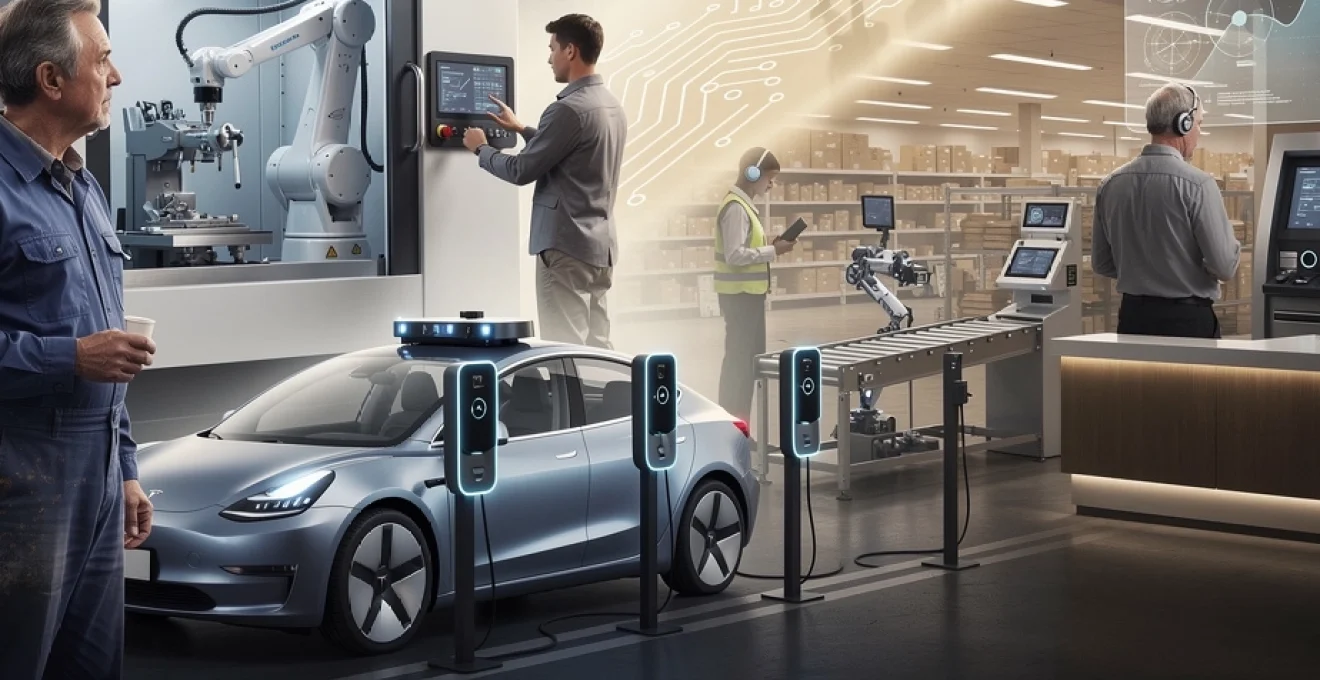
The British labour market stands at an unprecedented crossroads as technological advancement accelerates at breakneck speed. Recent research from the National Foundation for Educational Research reveals a stark reality: up to three million UK jobs in declining occupations could vanish by 2035, predominantly due to artificial intelligence and automation. This dramatic shift surpasses previous forecasts and signals a fundamental transformation of how we work, live, and earn our livelihoods.
Administrative roles, secretarial positions, customer service jobs, and machine operations are experiencing decline at rates far exceeding earlier predictions. Yet this isn’t simply a story of job destruction—it’s one of profound evolution. While traditional positions disappear, new opportunities emerge in professional and associate professional sectors, particularly in science, engineering, and legal fields. The challenge lies not in preventing change, but in preparing the workforce for what comes next through comprehensive reskilling and lifelong learning initiatives.
Manufacturing sector job displacement through industrial automation
The manufacturing landscape has undergone seismic shifts as smart technologies revolutionise production processes. Traditional manufacturing roles face unprecedented disruption, with automation technologies replacing human workers at an accelerating pace. This transformation affects millions of workers across various specialisations, from precision machining to textile production.
Industry 4.0 technologies have fundamentally altered manufacturing economics. Companies increasingly favour automated solutions that deliver consistent quality, operate continuously, and reduce long-term labour costs. The implications extend beyond individual job losses—entire communities built around manufacturing employment must now navigate economic restructuring.
CNC machinist roles replaced by computer numerical control systems
Computer Numerical Control systems have evolved from simple automated tools to sophisticated manufacturing platforms requiring minimal human intervention. Modern CNC machines incorporate artificial intelligence algorithms that optimise cutting paths, predict maintenance requirements, and adjust operations in real-time. These capabilities have dramatically reduced the need for traditional machinists who previously programmed and operated individual machines.
The transition affects approximately 180,000 CNC machinists across the UK. While some positions transform into CNC programmer roles requiring advanced technical skills, many traditional machinist positions become obsolete. Workers must now master complex software interfaces, understand advanced materials science, and develop problem-solving capabilities that complement automated systems.
Assembly line worker transitions due to robotic process automation
Robotic process automation has revolutionised assembly line operations across industries from automotive to electronics. Modern robotic systems perform repetitive tasks with precision levels unattainable by human workers, operating continuously without breaks, sick leave, or workplace safety concerns. These systems have displaced traditional assembly line positions while creating demand for robotics technicians and maintenance specialists.
The automotive sector exemplifies this transformation. Major manufacturers have replaced entire assembly line segments with robotic systems capable of welding, painting, and component installation. Workers who previously performed manual assembly tasks must now develop skills in robotics programming, system monitoring, and quality assurance protocols that complement automated production lines.
Quality control inspector evolution through machine vision technology
Machine vision technology has transformed quality control from a human-dependent process to an automated system capable of detecting defects invisible to the naked eye. Advanced cameras paired with artificial intelligence algorithms can identify microscopic flaws, dimensional variations, and surface imperfections at speeds impossible for human inspectors. This technology operates continuously, providing consistent quality assessment without fatigue or subjective interpretation.
Traditional quality control inspectors must now evolve into quality systems analysts who configure machine vision parameters, interpret automated reports, and handle complex exception cases. The role shifts from direct inspection to system oversight, requiring understanding of statistical analysis, machine learning algorithms, and advanced measurement technologies.
Textile worker decline following smart manufacturing implementation
Smart manufacturing technologies have automated numerous textile production processes, from spinning and weaving to cutting and finishing. Automated systems now handle pattern recognition, fabric cutting, and even complex stitching operations previously requiring skilled human operators. These technologies deliver consistent quality while operating at speeds far exceeding human capabilities.
The textile industry’s workforce must adapt to roles focused on system operation, maintenance, and design rather than direct production. Workers transition from manual fabric manipulation to managing automated cutting systems, programming embroidery machines, and coordinating between digital design platforms and production equipment. This shift requires developing digital literacy alongside
digital design capabilities. Those who successfully reposition themselves as textile technologists, CAD pattern designers, or production planners will find new opportunities in a sector that is smaller in headcount but higher in value-added output.
For many legacy textile workers, the critical pivot is from purely manual dexterity to data-informed decision-making. Understanding how to read production dashboards, monitor machine performance, and collaborate with engineers becomes just as important as knowing how a fabric behaves under tension. In practical terms, that means investing in basic coding, digital pattern software, and equipment diagnostics. Without these shifts, workers risk being left behind as smart factories demand a blend of hands-on experience and high-tech literacy.
Transportation industry workforce transformation via autonomous technologies
The transportation industry is undergoing a structural transformation as autonomous technologies, digital platforms, and real-time data systems reshape how goods and people move. Traditional roles based on manual driving, dispatching, and physical monitoring are steadily being augmented—or replaced—by software and sensors. This transition is not occurring overnight, but the trajectory is clear: more automation, fewer routine tasks, and a premium on oversight and system management.
For workers, this raises an urgent question: how do you stay relevant in a sector where algorithms increasingly make the decisions? The answer lies in shifting from being the “hands on the wheel” to the “mind behind the system”. Roles linked to fleet management, logistics optimisation, safety analytics, and human–machine coordination are growing even as legacy transportation jobs decline. Those who embrace continuous learning and digital tools will be best placed to navigate this new mobility landscape.
Commercial driver disruption through self-driving vehicle deployment
Self-driving vehicles are no longer a distant concept; pilot programmes for autonomous trucks, buses, and delivery vans are already active on UK and European roads. As these systems mature, they are expected to disrupt hundreds of thousands of commercial driving roles—from long-haul lorry drivers to local delivery drivers. Autonomous trucks operating on major motorways can run almost continuously, cutting costs and improving efficiency for logistics firms.
Yet even as manual driving roles decline, new positions are emerging in remote fleet supervision, autonomous vehicle safety operations, and logistics coordination. Think of a future driver not behind a single wheel, but overseeing a “swarm” of vehicles from a control centre, stepping in only when exceptions occur. To transition into these roles, drivers will need skills in telematics systems, basic data interpretation, and incident reporting, alongside the communication skills required to coordinate with customers and on-the-ground staff.
Taxi dispatcher obsolescence following uber and lyft algorithm integration
The rise of app-based ride-hailing has largely automated the traditional work of taxi dispatchers. Where once people manually matched drivers and passengers via radio, algorithms now assign rides in milliseconds based on location, traffic, and pricing data. This shift has made dispatcher roles in many urban centres either redundant or drastically reduced in number.
However, the underlying skill set—coordinating resources under time pressure, resolving conflicts, and ensuring service reliability—remains valuable. Former dispatchers can pivot into platform operations, customer support, or network optimisation roles within mobility companies and logistics providers. The key is learning to work with, rather than against, the algorithms: interpreting dashboard metrics, spotting anomalies, and escalating complex cases that automated systems cannot resolve on their own.
Parking attendant reduction due to smart meter and mobile payment systems
Smart parking meters, automatic number plate recognition, and mobile payment apps are steadily reducing the need for on-site parking attendants. Automated systems can track occupancy, issue digital tickets, and process payments without human intervention, particularly in city centres and large retail complexes. As a result, many traditional parking roles focused on cash handling and manual enforcement are disappearing.
New opportunities are arising in parking system administration, data-driven urban planning, and customer service for mobility services. Workers who once patrolled car parks can transition into monitoring parking networks from central control rooms, analysing usage patterns, and helping local authorities design better parking policies. Basic IT literacy, familiarity with mobile apps, and strong communication skills are now essential to succeed in these evolving roles.
Traffic control officer replacement by intelligent traffic management systems
Intelligent traffic management systems use cameras, sensors, and AI-powered analytics to adjust traffic lights, manage congestion, and detect incidents in real time. These systems reduce the need for human traffic officers manually directing vehicles at junctions or monitoring road conditions from the roadside. Over time, many on-street enforcement and control roles will be absorbed by software-driven platforms.
Yet as with other sectors, automation creates new forms of work. Traffic operations analysts, urban mobility planners, and system integrators are in growing demand to design, maintain, and fine-tune these complex networks. If you have experience in traffic enforcement or road safety, combining that practical knowledge with training in GIS tools, basic data analytics, or control-room operations can open doors to more resilient career paths in smart city management.
Financial services career obsolescence through fintech innovation
Financial services are experiencing one of the most rapid waves of automation, with fintech platforms streamlining processes that once required large back-office teams. From mobile banking apps to AI-driven risk models, technology is compressing transaction times, reducing errors, and fundamentally changing what it means to work in finance. Routine, rules-based tasks are particularly vulnerable, while roles involving complex problem-solving, regulation, and client relationships remain more resilient.
For professionals in banking and insurance, the message is clear: technical literacy and essential employment skills such as communication, problem-solving, and information literacy are no longer optional. As predictive analytics and digital platforms take over repetitive processes, workers who can interpret data, explain complex products clearly, and navigate ethical considerations will be in high demand. Those who cling to paper-based workflows and siloed knowledge risk being sidelined as fintech innovation accelerates.
Bank teller position decline following ATM and mobile banking adoption
Bank teller roles have been in gradual decline for years as ATMs, online banking, and mobile apps take over basic services like deposits, withdrawals, and balance checks. In many branches, the number of frontline staff has been cut significantly, and some locations have closed altogether. Customers increasingly expect to manage their money without ever speaking to a person.
Yet banks still need people—just not for stamping passbooks. Former tellers can transition into customer relationship specialists, financial wellbeing advisors, or fraud prevention analysts. These roles require deeper product knowledge, the ability to explain digital tools to customers, and a strong focus on trust-building. Upskilling in digital banking platforms, basic financial planning, and customer experience design can help frontline workers pivot away from transactional tasks towards higher-value advisory work.
Insurance underwriter role evolution via predictive analytics and AI assessment
Insurance underwriting, once a craft centred on individual judgement and paper-based files, is increasingly driven by predictive analytics and AI-powered risk models. These systems can process vast datasets—from telematics in cars to smart home sensors—to generate risk scores and pricing recommendations in seconds. As a result, many routine underwriting decisions are now automated, reducing demand for junior underwriters performing standard assessments.
This does not mean underwriting expertise is obsolete. Instead, the role is evolving into that of risk strategist and model overseer. Underwriters who can interpret complex models, challenge assumptions, and manage edge cases will remain crucial. To stay relevant, professionals should build skills in data literacy, regulatory compliance, and communication, ensuring they can translate algorithmic outputs into decisions that make sense for both the business and the customer.
Stock trader displacement through algorithmic trading and robo-advisors
In capital markets, algorithmic trading systems and high-frequency platforms execute orders far faster than any human trader could. Robo-advisors now offer automated investment portfolios to retail clients based on risk profiles and goals, often at a fraction of the cost of traditional advisers. This combination has reduced the number of roles for human traders handling standard orders and basic portfolio management.
However, human expertise remains vital in complex strategies, relationship management, and regulatory oversight. Former traders can transition into quantitative research, risk management, or client advisory positions that focus on bespoke solutions and nuanced decision-making. Developing programming skills (for example in Python or R), strengthening understanding of financial regulation, and honing communication skills can help displaced traders move into more sustainable, tech-augmented roles.
Mortgage processor automation via digital loan origination platforms
Digital loan origination platforms now handle much of the paperwork and verification work that once occupied large mortgage processing teams. Automated systems pull credit files, verify income, and cross-check documentation, allowing lenders to make decisions in days rather than weeks. As these tools become standard, many traditional processing roles focused on manual data entry and file chasing are disappearing.
Workers in this space can pivot into loan advisory, compliance analysis, or customer onboarding roles, where human interaction and judgement still add value. Imagine shifting from shuffling documents behind the scenes to guiding borrowers through complex financial decisions and digital tools. Skills in regulatory knowledge, digital customer service, and problem resolution will be key for those looking to transition as mortgage processing becomes increasingly automated.
Retail sector employment shifts due to e-commerce and digital integration
The retail sector has been reshaped by e-commerce, omnichannel strategies, and data-driven decision-making. Traditional high-street roles such as cashiers, stock clerks, and in-store sales associates are under pressure as online shopping, self-checkout, and automated inventory systems become the norm. At the same time, roles in digital marketing, warehouse automation, and customer experience design are expanding.
Rather than disappearing entirely, retail work is moving along the value chain—from point-of-sale transactions to logistics, analytics, and personalised service. Store staff who once focused on scanning barcodes are now expected to support click-and-collect services, manage online returns, and provide expert advice that digital channels cannot fully replicate. If you work in retail today, building skills in digital tools, social selling, and data-informed merchandising can help you transition into emerging roles that sit at the intersection of online and offline commerce.
Emerging career pathways in technology-driven industries
As declining occupations phase out, technology-driven industries are generating new career pathways that blend technical knowledge with the essential skills highlighted by the NFER: communication, collaboration, problem-solving, creative thinking, organising, and information literacy. These roles tend to be more resilient precisely because they rely on capabilities that complement, rather than compete with, automation. In many cases, your industry experience can be a powerful asset if you learn how to “translate” it into these new contexts.
So where are the new opportunities? Growth is especially strong in fields like data analytics, cybersecurity, green technologies, digital health, and advanced manufacturing. Often, entry routes exist that do not require a traditional degree but do demand targeted training and a willingness to learn. Think of these careers as new “tracks” built on the same ground you already know—your understanding of logistics, finance, or production can become a bridge into more technical roles if paired with the right reskilling.
Some of the most promising emerging pathways include:
- Automation and robotics technicians who install, maintain, and improve automated systems in factories, warehouses, and hospitals.
- Data and business analysts who turn operational data into insights for decision-makers across sectors.
- Cybersecurity analysts who protect organisations from digital threats as more work moves online.
- UX and customer experience specialists who ensure digital services are intuitive, accessible, and aligned with user needs.
- Green jobs in renewable energy, building retrofits, and sustainable supply chains that support the transition to a low-carbon economy.
Many of these roles reward the very skills automation struggles to replicate: empathy with customers, ethical judgement, and the ability to navigate ambiguous situations. Just as important, they often allow for hybrid and flexible working arrangements. If you are coming from a declining occupation, the first step is not to learn every new programming language, but to identify how your current strengths map onto these tech-enabled roles—and then fill in the specific technical gaps.
Reskilling strategies for transitioning professional workforce
Given the pace and scale of change, relying on initial education alone is no longer enough to secure a stable career. Lifelong learning—from early years through adulthood—must become the norm rather than the exception. Yet as the NFER research shows, many workers still underestimate the scale of the challenge, with 65 per cent confident they will naturally keep up with changing skill demands. In reality, we need deliberate reskilling strategies to navigate professions in decline and move into more sustainable roles.
Where should you start if your current job is at risk? Begin with an honest skills audit: list your daily tasks, the tools you use, and the situations where you solve problems or help others. Then compare this with job descriptions in growth areas like data analysis, digital operations, or customer experience. You will often find overlaps in soft skills and domain knowledge, even if the technical language looks unfamiliar at first. From there, you can plan targeted learning to close specific gaps rather than trying to reinvent yourself from scratch.
Effective reskilling typically rests on three practical pillars:
- Structured learning pathways. Short courses, micro-credentials, and bootcamps can provide focused training in areas like basic coding, data literacy, project management, or digital marketing. Many are available online and can be combined with work or caring responsibilities.
- On-the-job experience. Volunteering for digital projects, shadowing colleagues in new roles, or taking on hybrid responsibilities can give you the “hands-on” familiarity employers look for. Think of this as an apprenticeship in your own organisation.
- Supportive networks. Mentors, peer groups, unions, and professional bodies can help you understand labour market trends, access training funding, and stay motivated when change feels overwhelming.
Of course, responsibility for reskilling cannot fall on individuals alone. Employers and government both have critical roles to play in funding and facilitating career transitions. Companies can create internal academies, offer paid learning time, and redesign performance systems to reward skill development rather than just short-term outputs. Governments can invest in adult education, improve access to high-quality early years and school provision, and ensure disadvantaged groups are not left behind. Without this collective effort, we risk a future where millions of workers are stranded in declining professions with few routes forward.
Ultimately, preparing for professions in decline is less about predicting every future job and more about building adaptable, transferable capabilities. If you focus on strengthening your essential employment skills—communication, collaboration, problem-solving, creative thinking, organising, and information literacy—while layering on relevant technical knowledge, you will be better positioned to navigate whatever comes next. The labour market of 2035 will look very different from today’s, but with a strategic approach to reskilling, it can still offer meaningful, secure work for those ready to evolve with it.