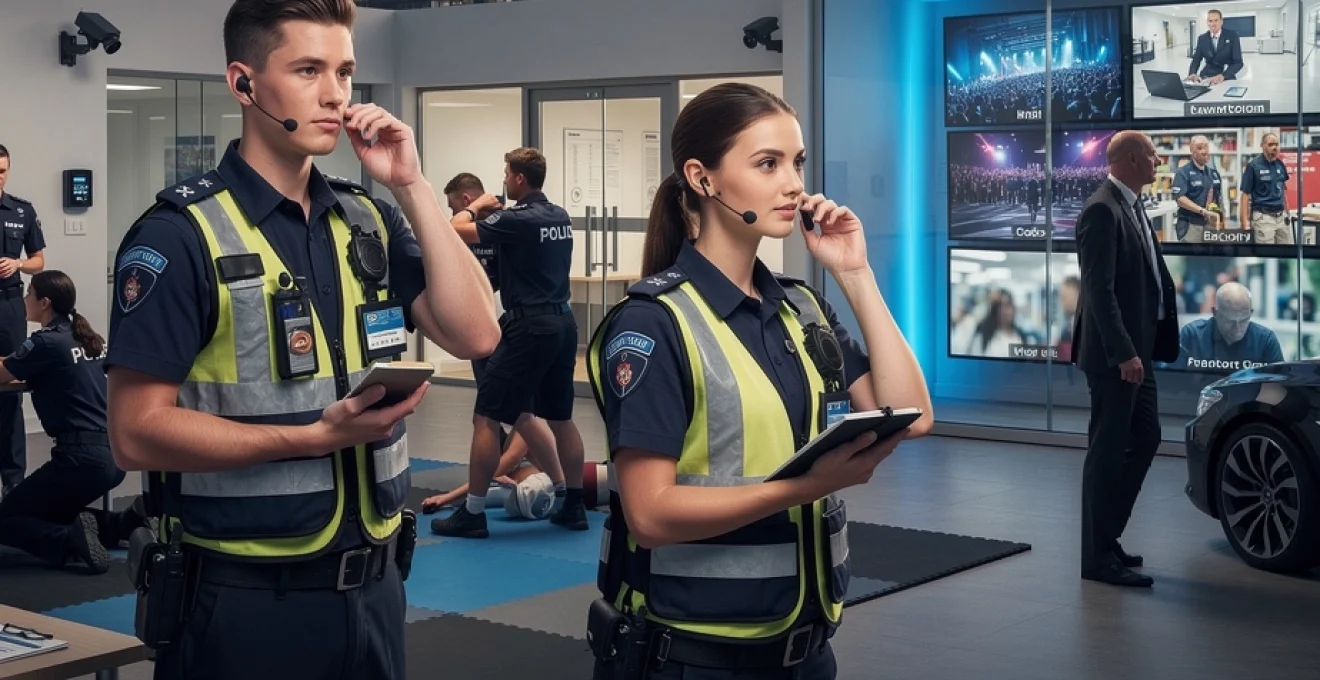
The private security industry in the United Kingdom has experienced remarkable growth over the past two decades, evolving from an unregulated sector into a professional field requiring specific qualifications and licensing. With over 400,000 licensed security professionals currently operating across the UK, this dynamic sector offers diverse career opportunities ranging from corporate security roles to specialised close protection services. The introduction of the Private Security Industry Act 2001 fundamentally transformed the landscape, establishing rigorous standards that ensure only qualified individuals can pursue careers in security services.
Modern security professionals command respect through their expertise in risk assessment, conflict resolution, and emergency response protocols. The industry’s transformation has created pathways for career advancement that were previously unavailable, with experienced operatives progressing to supervisory roles, specialist positions, and even establishing their own security consultancies. Whether you’re seeking flexible part-time work or pursuing a long-term career with substantial earning potential, the private security sector provides structured opportunities for professional development and financial growth.
Essential qualifications and licensing requirements for private security personnel
The foundation of any successful career in private security begins with understanding the mandatory qualifications and licensing framework established by the Security Industry Authority. These requirements ensure that all security professionals meet stringent standards for competency, integrity, and professional conduct. The regulatory framework protects both security operatives and the clients they serve, creating a trusted environment where skilled professionals can build sustainable careers.
SIA (security industry authority) licence application process and door supervision certification
Obtaining an SIA licence represents the most crucial step for anyone entering the private security industry. The application process requires completion of an approved training course, followed by a comprehensive application that includes identity verification and background checks. The standard Security Guard licence costs £184 and remains valid for three years, providing access to numerous employment opportunities across retail, corporate, and residential security sectors.
The Door Supervision licence offers enhanced versatility, enabling operatives to work in licensed premises such as pubs, clubs, and entertainment venues. This certification includes additional training in physical intervention techniques and conflict management strategies specific to licensed environments. Door supervisors typically command higher hourly rates, often earning £13-£25 per hour compared to £10-£17 for standard security guard positions.
Criminal records bureau (CRB) enhanced disclosure and background verification standards
Background verification forms an integral component of the SIA licensing process, with all applicants undergoing thorough criminal record checks. The Security Industry Authority reviews criminal history spanning the previous ten years, though certain convictions may result in permanent exclusion from the industry. Enhanced DBS checks are mandatory for positions involving vulnerable adults or children, ensuring the highest standards of safeguarding compliance.
Applicants with minor criminal convictions may still qualify for licensing, as the SIA considers factors such as the nature of offences, rehabilitation efforts, and time elapsed since conviction. The organisation maintains detailed guidelines outlining which convictions typically result in licence refusal, providing transparency for potential applicants assessing their eligibility before investing in training programmes.
First aid certification requirements and emergency response training protocols
Emergency First Aid at Work certification represents a mandatory requirement for all SIA licence applications, reflecting the critical importance of medical response capabilities in security roles. This qualification covers essential life-saving techniques including CPR, treatment of unconscious casualties, and management of wounds and bleeding. The certification remains valid for three years and must be renewed to maintain SIA licence eligibility.
Beyond basic first aid, many employers seek operatives with enhanced emergency response training, including incident management and evacuation procedures. Advanced certifications in fire safety, crowd control, and emergency communication protocols significantly enhance employment prospects and earning potential within specialised security environments such as large-scale events or high-risk facilities.
Physical fitness standards and medical clearance documentation
While the SIA does not impose specific physical fitness requirements, employers across the security industry maintain varying standards based on role demands. Static security positions may require extended periods of standing and walking, whilst mobile patrol roles involve more intensive physical activity. Event security positions often demand higher fitness levels due to crowd management responsibilities and emergency response requirements.
Medical clearance documentation may be requested for certain positions, particularly those involving close protection work or high-risk environments. Prospective security professionals should consider their physical capabilities when selecting career pathways, as different
career paths place differing emphasis on strength, stamina, and mobility. You are not required to be an elite athlete, but maintaining above-average fitness and the ability to stand, walk, and respond quickly under pressure will make you a stronger candidate. Where roles involve significant physical intervention or long patrols, employers may request medical reports from your GP or occupational health providers to confirm you are fit for duty. Preparing early by improving your cardiovascular fitness, flexibility, and overall health can help you meet these informal but important physical standards.
Core training programmes and professional development pathways
Once you understand the basic licensing requirements, the next step is to consider which core training programmes will best support your long-term goals in private security services. The UK security training framework is structured, allowing you to progress from entry-level qualifications to advanced specialist certifications. Think of this as building a toolkit: each course adds another set of skills, making you more employable, more versatile, and better placed for promotion into supervisory or specialist roles.
Level 2 certificate in security operations and conflict management techniques
The Level 2 Certificate in Security Guarding or Security Operations is the foundational qualification for most manned guarding roles. Typically delivered over four to six days, it combines classroom-based learning with practical assessments, covering key topics such as legal responsibilities, communication, patrolling methods, and incident reporting. You will also study how to work effectively as part of a wider security team, often alongside CCTV operators, reception staff, or law enforcement.
Conflict management forms a major part of the Level 2 curriculum and is critical for anyone who will interact with the public. Rather than focusing on physical strength, this training teaches you how to recognise early signs of aggression, use body language and verbal skills to de-escalate tension, and apply proportionate responses when situations escalate. Effective conflict management is like having a pressure-release valve: it allows you to defuse situations before they reach the point of physical confrontation, protecting both you and the people you are responsible for.
Many training centres now include scenario-based exercises, where you practise dealing with challenging customers, intoxicated individuals, or trespassers in a controlled environment. This practical approach helps you bridge the gap between theory and real life, giving you the confidence to handle difficult situations calmly. Because employers know the Level 2 Certificate is aligned with SIA standards, holding this qualification immediately signals that you understand the legal framework, use-of-force principles, and customer service expectations that underpin modern private security services.
CCTV surveillance training and digital monitoring systems proficiency
CCTV operation has become one of the most important specialisms in private security, particularly as organisations invest in advanced digital monitoring systems and remote supervision solutions. To work legally as a CCTV operator in public space surveillance, you must complete an SIA-approved CCTV training course and obtain the relevant SIA CCTV licence. This qualification covers not only the technical operation of cameras but also data protection, privacy laws, and evidence handling procedures.
During CCTV training, you will learn how to monitor multiple screens simultaneously, identify suspicious behaviour, track individuals across camera networks, and create incident logs that can be used by police or management. In many ways, a CCTV operator functions like an air-traffic controller for security: you may not be physically on the ground, but your observations guide the actions of on-site guards and emergency responders. The ability to stay alert, focus for extended periods, and communicate concise, accurate information is more important than physical strength in this role.
With the rise of networked CCTV systems, video analytics, and remote monitoring centres, familiarity with digital platforms and software is increasingly valuable. You do not need to be an IT expert, but being comfortable with basic computer use, logging events, and navigating security management software will help you stand out. Many professionals combine a manned guarding or door supervision licence with CCTV training, expanding their job options to include control room roles in shopping centres, hospitals, corporate offices, and local authority surveillance hubs.
Close protection training through approved ACS (approved contractor scheme) providers
Close protection (CP) is one of the most prestigious and demanding branches of private security services, involving the protection of high-profile clients such as executives, celebrities, diplomats, or high-net-worth individuals. To work as a close protection officer (CPO) in the UK, you must complete an SIA-approved Level 3 Close Protection qualification and apply for the dedicated CP licence. Training is typically intensive, lasting from 12 to 20 days, and is often delivered by providers who are part of the SIA’s Approved Contractor Scheme (ACS).
The close protection syllabus encompasses risk assessment, route planning, surveillance awareness, escort formation, and both covert and overt protection techniques. You will also cover advanced conflict management, emergency first aid (often at a higher level than standard EFAW), and sometimes defensive driving. In many ways, close protection work is like playing high-level chess in real time: you must constantly think several moves ahead, identifying threats before they materialise and adjusting plans to keep your principal safe without disrupting their routine.
Because close protection assignments can be demanding and sometimes involve international travel, employers look for candidates with a high level of professionalism, discretion, and fitness. A background in the military, police, or other uniformed services is common but not mandatory. If you are aiming for this path, it is worth starting with door supervision or security guarding roles to build experience, while gradually working towards CP training with an established ACS provider that offers realistic scenarios and strong employment links.
Counter-terrorism awareness and risk assessment methodologies
In today’s security environment, counter-terrorism awareness is no longer restricted to specialist units; it is becoming a standard expectation for many frontline security officers. Training in this area equips you with the skills to recognise suspicious behaviour, identify potential hostile reconnaissance, and understand how different threat levels influence security posture. Rather than turning every incident into a crisis, counter-terrorism awareness helps you distinguish between normal public behaviour and genuine warning signs that require escalation.
Risk assessment methodologies are central to effective counter-terrorism practice. You will learn to evaluate vulnerabilities at a site, consider possible attack methods, and recommend proportionate control measures such as access controls, vehicle barriers, search procedures, or staff briefings. A useful analogy is that of a chain: a security system is only as strong as its weakest link, so your role is to identify and strengthen those links before they are exploited. This analytical approach is particularly important in crowded places like shopping centres, stadiums, and transport hubs.
Many employers encourage staff to complete recognised awareness courses such as the UK government’s ACT (Action Counters Terrorism) e-learning modules or equivalent programmes. Adding counter-terrorism awareness and basic risk assessment training to your CV demonstrates that you understand the broader threat landscape and can contribute to a layered security strategy, making you more attractive to large corporate clients, event organisers, and critical infrastructure operators.
Major private security sector opportunities and career specialisations
Once you have secured your SIA licence and core qualifications, the next question is: where do you want your career in private security to take you? The sector is far more diverse than many people realise, spanning everything from uniformed guarding in office buildings to high-risk maritime operations off international coasts. By understanding the main areas of employment, you can target roles that match your skills, personality, and long-term ambitions.
Corporate security roles with G4S, securitas, and mitie security services
Corporate security positions with major providers such as G4S, Securitas, and Mitie offer structured career paths, regular hours, and access to large client portfolios. These roles often involve manned guarding, reception security, access control, and building patrols in environments like corporate offices, data centres, financial institutions, and government buildings. For many newcomers, corporate security is an excellent entry point into the industry, providing stable employment and clear procedures.
Working for a large security company can be compared to joining a major airline as a new pilot: you start with defined routes and protocols, but over time you can progress to more complex assignments or supervisory roles. Many of these organisations run internal training academies, leadership development programmes, and specialised courses in fire safety, risk assessment, and customer service. With consistent performance and a professional attitude, it is realistic to progress from security officer to site supervisor, contract manager, and regional operations manager.
Corporate security roles usually require strong communication and customer service skills, as you will interact daily with staff, visitors, and contractors. You may be responsible for issuing visitor passes, monitoring CCTV, responding to alarms, and producing incident reports that feed into broader risk management strategies. If you value predictable schedules, a professional environment, and the possibility of long-term progression within a single organisation, corporate security with a major provider is a compelling option.
Event security management for festivals, concerts, and sporting venues
Event security is one of the most visible and dynamic specialisations in private security services. From music festivals and football matches to conferences and cultural events, trained officers are required to manage access control, crowd safety, and emergency procedures. Door supervisors are particularly sought after in this sector, as their licence covers both static guarding and work in licensed premises where alcohol is served.
Working event security can feel fast-paced and unpredictable, making it attractive if you prefer variety over routine. One week you might be checking tickets at a stadium, the next you could be monitoring backstage access at a concert or overseeing VIP hospitality areas. Key responsibilities include bag searches, stewarding, monitoring crowd density, and responding calmly to incidents such as lost children, medical emergencies, or disorderly behaviour.
As you gain experience, you can move into supervisory positions such as team leader, zone manager, or safety officer, where you will participate in pre-event risk assessments, staff briefings, and post-event debriefs. Event security management requires excellent communication skills, quick decision-making, and the ability to remain composed in front of large crowds. If you enjoy working outdoors, thrive under pressure, and appreciate a flexible work schedule that may include evenings and weekends, this could be a rewarding path.
Retail loss prevention and asset protection specialist positions
Retail security and loss prevention roles focus on protecting stock, staff, and customers in environments such as supermarkets, department stores, and high-street retailers. While traditional “store detective” roles still exist, modern retail security has evolved into a more analytical and customer-focused profession, often integrating CCTV monitoring, covert surveillance, and data-driven strategies to reduce theft and fraud.
As a retail security officer, you might be responsible for monitoring entrances and exits, conducting bag checks, liaising with store management, and gathering evidence of shoplifting or internal theft. Loss prevention specialists go a step further by analysing shrinkage patterns, reviewing CCTV footage, and recommending procedural changes to reduce vulnerabilities. In this sense, you act both as a visible deterrent and a behind-the-scenes investigator.
Because retail environments are highly customer-facing, strong interpersonal skills and a calm, non-confrontational approach are essential. You will often work closely with local police, providing witness statements and sharing intelligence about repeat offenders. With experience, you can progress to regional loss prevention management roles, overseeing security strategies across multiple stores and contributing to broader corporate risk management initiatives.
Maritime security operations and port authority contracts
Maritime security is a niche but critical area within private security services, involving the protection of ships, ports, and offshore assets. Roles can range from static guarding at port facilities and container terminals to embarked security teams on vessels transiting high-risk areas affected by piracy or organised crime. Because of the specialised nature of the work, many maritime positions require additional training in shipboard operations, international maritime law, and specific rules of engagement.
Port authority contracts often involve access control for restricted areas, vehicle and cargo screening, and coordination with customs, immigration, and coastguard agencies. In these environments, security officers become part of a wider safety and compliance ecosystem, ensuring that international regulations such as the ISPS (International Ship and Port Facility Security) Code are followed. A background in the military or maritime sector can be advantageous, but entry-level roles are sometimes available for candidates with strong discipline and a willingness to undertake further training.
Maritime assignments at sea can be physically and mentally demanding, involving extended periods away from home and the need to adapt to confined living conditions. However, they can also be financially rewarding, with higher daily rates reflecting the additional risk and responsibility. If you are drawn to a more adventurous career path and are prepared for the lifestyle it entails, maritime security offers unique experiences that traditional land-based roles cannot match.
Executive protection services and VIP security assignments
Executive protection and VIP security represent the high end of the private security market, where clients expect a discreet, polished service that integrates seamlessly with their professional and personal lives. Unlike uniformed guarding, executive protection is often low-profile, with operatives dressed to blend into corporate or social settings while maintaining constant awareness of potential threats. Assignments may include business travel, public appearances, and residential security for high-net-worth individuals.
To succeed in this sector, you will typically need a close protection licence, excellent communication skills, and the ability to operate both independently and as part of a multi-disciplinary team. Language skills, cultural awareness, and a professional demeanour can be as important as physical capabilities. Because executive protection often involves international travel, knowledge of different legal systems, customs, and security threats is invaluable.
Competition for VIP security roles can be intense, but the rewards include higher daily rates and the opportunity to work in diverse environments around the world. Networking, reputation, and proven reliability are crucial; many assignments are secured through referrals rather than public job adverts. For this reason, building a strong track record in other security disciplines before transitioning into executive protection is a common and effective strategy.
Technology integration and modern security equipment proficiency
Technology now underpins almost every aspect of private security services, from access control and CCTV to incident reporting and intelligence sharing. As a modern security professional, your ability to understand and operate security technology can significantly influence your employability and career progression. Rather than replacing human officers, technology acts as a force multiplier, enabling you to monitor larger areas, respond faster, and provide better evidence when incidents occur.
On a day-to-day basis, you may be expected to use electronic access control systems, handheld radios, body-worn cameras, alarm panels, and digital incident-logging platforms. Many sites also deploy visitor management software, automatic number plate recognition (ANPR), and integrated security management systems that bring CCTV, alarms, and access control into a single interface. Being comfortable with these tools is increasingly considered a basic requirement rather than an advanced skill.
Developing proficiency with modern equipment does not mean becoming an engineer; it means learning how to operate, troubleshoot, and report issues with the tools you rely on. For example, understanding how to bookmark critical CCTV footage, tag it correctly for evidential use, and ensure it is stored in line with data protection rules can significantly enhance the value of your incident reports. In effect, you become both the “eyes and ears” and the digital recorder of what happens on site.
Many employers provide on-site training for specific systems, but you can also take the initiative by familiarising yourself with common industry technologies and basic IT skills. As artificial intelligence and video analytics become more widespread, security officers who can interpret automated alerts, verify their accuracy, and make sound decisions based on data will be in particularly high demand. Embracing technology early in your career will help you stay relevant in a sector that is rapidly modernising.
Professional networking and industry advancement strategies
Technical skills and licences are essential, but they are only part of the equation when building a long-term career in private security services. Professional networking, reputation management, and strategic career planning can have just as much impact on your opportunities. In an industry where many contracts and specialist assignments are filled through recommendations, who you know – and how you are known – really does matter.
Joining professional organisations such as the International Professional Security Association (IPSA) or the Security Institute can connect you with experienced practitioners, training opportunities, and industry events. These bodies often host webinars, conferences, and local meet-ups where you can learn about emerging trends, share best practices, and meet potential employers or mentors. Treat these events as an investment in your future; one useful contact or piece of advice can shape your next career move.
Online platforms also play a role. Maintaining an up-to-date, professional profile on sites like LinkedIn allows recruiters and security managers to verify your licences, training, and work history. Sharing insights, engaging with industry discussions, and joining specialist groups (for example, focused on close protection, event security, or maritime operations) can raise your profile. Think of your online presence as a living CV that demonstrates not just what you have done, but how you think and communicate.
Within your current role, advancement often comes from consistently demonstrating reliability, integrity, and initiative. Volunteering for additional responsibilities, mentoring new staff, or contributing to site risk assessments can signal that you are ready for supervision or management. Many companies prefer to promote from within, so building a strong reputation on one contract can lead to opportunities across a broader portfolio. Regularly reviewing your goals – asking yourself where you want to be in one, three, or five years – will help you choose the right courses and roles to keep your career moving forward.
Salary expectations and career progression framework in UK security services
Understanding typical salary ranges and progression opportunities in UK private security services will help you set realistic expectations and make informed career decisions. Entry-level security guard and door supervisor roles often start near the National Living Wage, but rates vary significantly by region, risk level, and specialism. In major cities and high-risk environments, pay can be markedly higher due to greater demand and responsibility.
As a general guide, many door supervisors and experienced security guards earn between £12 and £17 per hour, with premium rates of £18 to £25 per hour for high-profile events or demanding nightlife venues. Close protection officers, particularly those working with high-risk clients or on overseas assignments, can command day rates that equate to £50 to £100 per hour, reflecting the specialised skills and higher stakes involved. CCTV operators and control room staff often earn comparable rates to corporate security officers, with opportunities for shift allowances for night work.
Career progression in private security typically follows a pathway from frontline roles to supervisory and management positions. After gaining experience as a security officer or door supervisor, you might move into roles such as team leader, site supervisor, or control room supervisor. From there, opportunities include contract manager, operations manager, regional manager, and ultimately senior leadership positions overseeing multiple contracts or business units. Each step up usually involves a mix of additional training, greater responsibility for staff and budgets, and closer engagement with clients.
Specialisation can also drive salary growth. By focusing on niches such as maritime security, executive protection, or high-risk industrial sites, you can often achieve higher rates than in general guarding. The key is to view your career as a long-term project: by steadily adding qualifications, building experience in different environments, and cultivating a strong professional network, you increase both your earning potential and your resilience to changes in the market. In a sector that operates 24 hours a day, 365 days a year, motivated professionals who invest in their development will continue to find new and rewarding opportunities.