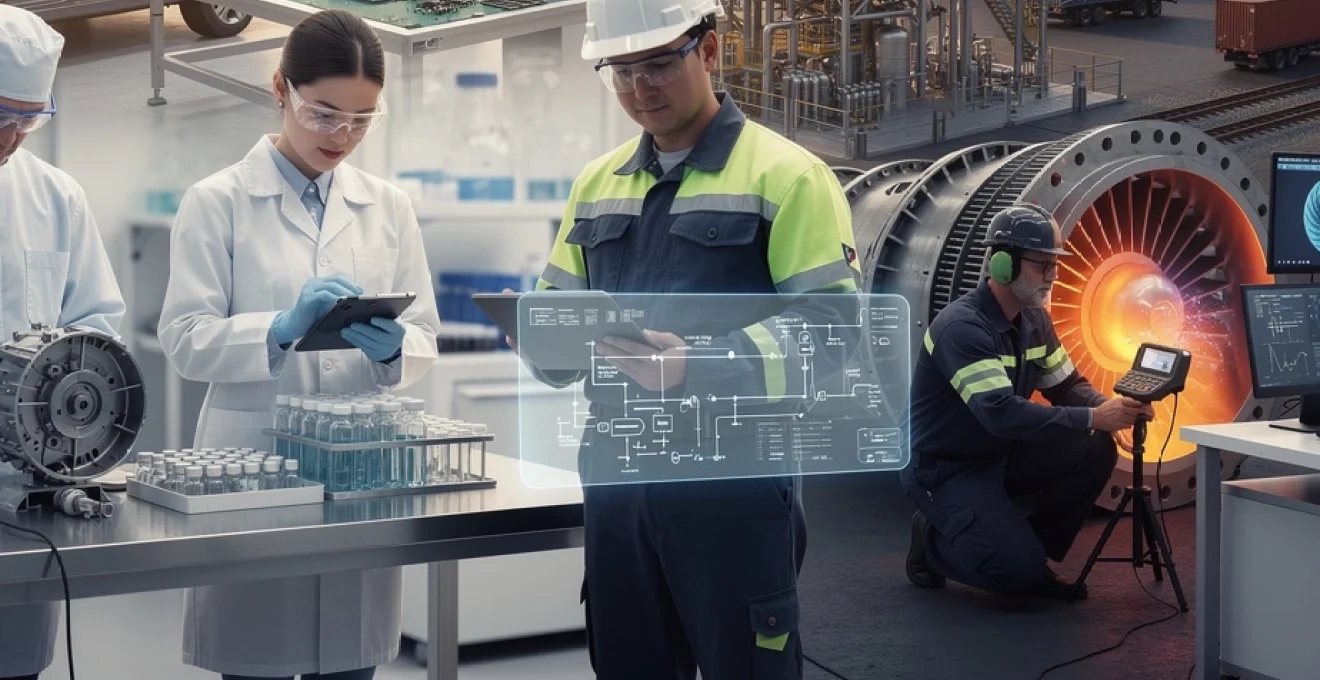
Behind every successful manufacturing plant, power station, and industrial facility lies a network of highly skilled professionals whose contributions often go unnoticed by the general public. These essential workers ensure that complex systems operate smoothly, products meet stringent quality standards, and operations comply with rigorous safety regulations. From automotive assembly lines to pharmaceutical production facilities, these unsung heroes form the backbone of modern industrial operations.
The sophistication of today’s industrial landscape demands expertise that extends far beyond traditional manufacturing roles. Quality assurance engineers implement statistical process control systems that prevent costly defects, whilst industrial maintenance technicians utilise advanced predictive analytics to prevent equipment failures before they occur. Supply chain logistics coordinators orchestrate complex multi-modal transportation networks, and environmental compliance specialists ensure adherence to ever-evolving regulatory frameworks.
Understanding these critical roles provides valuable insight into how major industries maintain their competitive edge whilst managing increasingly complex operational challenges. The professionals filling these positions combine technical expertise with analytical thinking, ensuring that industrial operations remain efficient, safe, and profitable in an era of rapid technological advancement.
Quality assurance engineers: safeguarding manufacturing excellence in automotive and pharmaceuticals
Quality assurance engineers serve as the guardians of manufacturing excellence, implementing comprehensive systems that ensure products meet exacting specifications before reaching consumers. These professionals design and execute testing protocols, analyse production data, and establish quality metrics that drive continuous improvement across diverse industrial sectors. Their work extends beyond simple inspection, encompassing the development of sophisticated quality management systems that integrate seamlessly with modern manufacturing processes.
In today’s competitive marketplace, quality assurance engineers must possess a unique combination of technical knowledge and analytical skills. They design experiments to identify potential failure modes, develop statistical models to predict quality outcomes, and collaborate with production teams to implement corrective actions. The role requires deep understanding of industry-specific regulations, international quality standards, and emerging technologies that can enhance product reliability and customer satisfaction.
Statistical process control implementation in toyota production systems
The Toyota Production System represents a pinnacle of manufacturing excellence, largely due to rigorous statistical process control implementation by quality assurance engineers. These professionals establish control charts that monitor key process variables in real-time, enabling immediate detection of variations that could compromise product quality. Through careful analysis of process capability indices, they ensure that manufacturing operations consistently produce components within specified tolerances.
Quality engineers at Toyota facilities utilise advanced SPC software to analyse vast amounts of production data, identifying trends and patterns that might indicate emerging quality issues. Their work involves establishing sampling protocols, training production staff on quality procedures, and developing automated inspection systems that can detect defects at unprecedented speed and accuracy. This systematic approach has enabled Toyota to achieve defect rates measured in parts per million rather than percentages.
Good manufacturing practice compliance monitoring at GSK and pfizer facilities
Pharmaceutical quality assurance engineers operate within one of the most highly regulated industries, where Good Manufacturing Practice compliance is not merely recommended but legally mandated. These professionals develop and maintain comprehensive quality management systems that ensure every aspect of drug production meets stringent regulatory requirements. Their work encompasses everything from raw material qualification to final product release, with meticulous documentation requirements that create complete traceability throughout the manufacturing process.
At facilities operated by pharmaceutical giants like GSK and Pfizer, quality assurance engineers conduct regular audits of manufacturing processes, equipment calibration records, and environmental monitoring data. They collaborate closely with regulatory affairs teams to prepare for inspections by agencies such as the FDA and EMA, ensuring that all documentation meets current regulatory expectations. The complexity of modern pharmaceutical manufacturing requires these professionals to maintain expertise in multiple therapeutic areas, understanding the unique quality challenges associated with different drug delivery systems and manufacturing technologies.
Six sigma black belt methodologies for defect prevention in electronics manufacturing
Electronics manufacturing presents unique quality challenges due to the miniaturisation of components and the complexity of modern circuit designs. Quality assurance engineers in this sector often hold Six Sigma Black Belt certifications, enabling them to lead sophisticated improvement projects that reduce defect rates to near-zero levels. These professionals utilise DMAIC (Define, Measure, Analyse, Improve, Control) methodology to systematically address quality issues, employing statistical tools to identify root causes and validate improvement solutions.
The implementation of Six Sigma methodologies in electronics manufacturing involves careful analysis of process variables such as temperature profiles during
temperature-controlled soldering, humidity levels in cleanrooms, and component placement accuracy on high-speed pick-and-place machines. By correlating these parameters with field failure data and in-circuit test results, they can pinpoint subtle process drifts long before they translate into large-scale quality escapes.
In practice, Six Sigma Black Belts lead cross-functional teams that redesign workflows, optimise equipment settings, and standardise work instructions to eliminate sources of variability. They may, for example, introduce tighter reflow oven profiling to reduce cold solder joints, or implement automated optical inspection algorithms tuned to detect micro-cracks on densely packed boards. Once improvements are validated through statistically significant trials, control plans and monitoring dashboards ensure that the gains are locked in. This disciplined, data-driven approach helps electronics manufacturers maintain ultra-low defect rates even as products become more complex and life cycles shorten.
ISO 9001:2015 audit trail management in aerospace component production
Aerospace component manufacturers operate in an environment where documentation can be as critical as the hardware itself. Quality assurance engineers working under ISO 9001:2015 frameworks design and maintain exhaustive audit trails that track every step of production, from material batch numbers to torque values on critical fasteners. These records not only support regulatory compliance with authorities such as EASA and the FAA, but also enable rapid root cause analysis if a non-conformance is detected in service.
To manage this level of traceability, quality teams implement integrated quality management systems that link enterprise resource planning data with shop-floor execution systems. Operators record process steps via barcodes or RFID scanners, and deviations trigger automated non-conformance reports that must be investigated and closed with documented corrective actions. In many plants, digital signatures and time-stamped records replace paper-based systems, reducing the risk of human error and lost documentation. The result is an end-to-end quality chain where every part can be traced back through its complete manufacturing and inspection history within minutes.
Industrial maintenance technicians: predictive analytics and equipment reliability
Industrial maintenance technicians are the frontline defenders of equipment reliability in heavy industry, power generation, and large-scale manufacturing. Rather than simply reacting to breakdowns, modern technicians work within predictive maintenance programs that rely on real-time data, condition monitoring, and advanced diagnostics. By intervening before a failure occurs, they help organisations minimise unplanned downtime, protect expensive assets, and maintain stable production schedules.
These professionals interpret vibration spectra, thermal images, oil analysis reports, and SCADA alarms to understand how machines are behaving under load. They collaborate closely with reliability engineers to prioritise interventions based on risk and criticality, focusing on assets whose failure would have the greatest operational impact. As industrial facilities become more connected, maintenance technicians increasingly need hybrid skills: mechanical and electrical expertise combined with comfort using analytics dashboards, handheld diagnostic devices, and computerised maintenance management systems.
Vibration analysis using SKF condition monitoring systems
Vibration analysis is one of the most powerful tools for identifying mechanical problems in rotating equipment long before they become catastrophic. Maintenance technicians use SKF condition monitoring systems to capture vibration signatures from motors, pumps, gearboxes, and turbines operating under normal conditions. These systems compare live data against baseline patterns to detect anomalies that may indicate bearing wear, misalignment, imbalance, or looseness.
Interpreting these spectra is both an art and a science. Technicians learn to recognise characteristic frequency peaks associated with specific failure modes, much like a physician reading an ECG. For example, a developing bearing fault might manifest as harmonics at the bearing defect frequency, while misalignment could create higher axial vibration levels. By scheduling targeted interventions based on these insights, plants can replace components at the optimal time, extending asset life and reducing emergency call-outs that disrupt production.
Thermographic inspection protocols for power generation turbines
In power generation facilities, thermographic inspections provide a non-intrusive window into the health of high-value assets such as gas and steam turbines. Industrial maintenance technicians use infrared cameras to capture temperature distributions on casings, electrical connections, insulation, and auxiliary systems while equipment is operating. Abnormal hot spots or unexpected temperature gradients can point to issues such as insulation breakdown, air leaks, electrical resistance, or lubrication problems.
Effective thermographic inspection protocols define when surveys should be conducted, which assets must be scanned, and how results are documented and trended over time. Technicians classify anomalies by severity and urgency, feeding this information into risk-based maintenance plans. Because thermal patterns can change subtly over months, consistent imaging angles and environmental conditions are critical to avoid false alarms. When combined with other condition monitoring techniques, thermography helps power stations maintain high availability and avoid the kind of failures that can take gigawatts of capacity offline in an instant.
SCADA integration for real-time asset performance management
Supervisory control and data acquisition (SCADA) systems sit at the heart of modern industrial facilities, streaming data from thousands of sensors on pumps, conveyors, reactors, and compressors. Industrial maintenance technicians increasingly rely on SCADA-integrated dashboards to spot early warning signs of trouble, such as rising motor currents, abnormal temperature trends, or frequent trip events. Rather than waiting for operators to report a problem, technicians can receive automated alerts when readings move outside defined control bands.
Real-time asset performance management goes beyond simple alarms. By linking SCADA data to maintenance histories and reliability models, organisations can calculate health scores for critical equipment and predict remaining useful life. Technicians then align their work orders with these insights, prioritising assets at highest risk of failure. This approach turns maintenance from a cost centre into a strategic function: every intervention is backed by data, and you can justify investment in upgrades or spare parts based on quantified risk reduction.
Root cause analysis techniques in petrochemical refinery operations
When equipment failures occur in petrochemical refineries, the consequences can range from production losses to serious safety incidents. Industrial maintenance technicians play a central role in structured root cause analysis, working alongside process engineers and safety specialists to determine not just what failed, but why it failed. Techniques such as the 5 Whys, fishbone diagrams, and fault tree analysis help teams move beyond superficial explanations like “operator error” or “component fatigue.”
In practice, a root cause investigation might trace a pump failure back to inadequate lubrication schedules, which in turn were caused by unclear maintenance procedures and incomplete training. By identifying and addressing these systemic issues, refineries can prevent recurrence rather than simply replacing failed parts. Over time, a culture of thorough root cause analysis builds a knowledge base of failure modes and corrective actions, enabling continuous improvement in reliability, safety, and overall equipment effectiveness.
Supply chain logistics coordinators: multi-modal transportation orchestration
Supply chain logistics coordinators are the conductors of the industrial orchestra, ensuring that raw materials, components, and finished goods move efficiently across global networks. Their work spans multi-modal transportation orchestration, balancing costs, lead times, and risk across road, rail, sea, and air freight. In industries such as automotive, chemicals, and consumer goods, a single delay at a port or rail terminal can ripple through the entire value chain, making these professionals critical to day-to-day stability.
Using transportation management systems and real-time tracking platforms, logistics coordinators model alternative routes, consolidate shipments, and negotiate with carriers to maintain service levels. They must constantly weigh trade-offs: is it worth paying a premium for air freight to prevent a production line stoppage, or can inventory buffers absorb a longer transit time by sea? As volatility increases due to geopolitical events and climate-related disruptions, their ability to design resilient routing strategies becomes a key competitive advantage.
On the ground, these specialists manage time-sensitive handoffs between modes, coordinating with warehouse teams, customs brokers, and third-party logistics providers. They monitor key performance indicators such as on-time delivery rates, dwell times, and freight cost per unit, using this data to drive continuous improvement. For professionals looking to future-proof their careers in logistics, building skills in data analytics and digital freight platforms is becoming as important as understanding traditional transportation regulations.
Environmental compliance specialists: regulatory adherence across heavy industries
Environmental compliance specialists ensure that heavy industries operate within the boundaries of increasingly stringent environmental regulations. Working in sectors like mining, steel production, petrochemicals, and power generation, they monitor emissions, waste streams, and resource consumption to align operations with local, national, and international standards. Their role sits at the intersection of engineering, law, and sustainability, translating complex regulatory texts into practical operating procedures.
These professionals design monitoring programs for air, water, and soil, specifying where measurements must be taken, how often, and with which analytical methods. They analyse results against permit limits and environmental quality standards, flagging non-compliances and coordinating corrective actions with plant managers. In many operations, environmental specialists also lead environmental impact assessments for new projects, engaging with regulators and local communities to address concerns before construction begins. As carbon pricing and ESG reporting expand, their work increasingly feeds into corporate strategy and investor communications.
From an operational perspective, environmental compliance can feel like a constraint, but effective specialists frame it as a driver of innovation and risk reduction. By identifying opportunities to reduce emissions, recycle process water, or recover waste heat, they help companies cut costs and improve their sustainability profile at the same time. The most successful professionals in this field keep pace with evolving regulations and emerging technologies, ensuring their organisations are prepared rather than simply reacting under time pressure.
Process safety engineers: risk assessment and hazard mitigation strategies
Process safety engineers focus on preventing low-probability, high-consequence events in industries that handle hazardous materials and high energies. Unlike occupational safety, which targets slips, trips, and falls, process safety addresses catastrophic risks: explosions, toxic releases, runaway reactions, and structural failures. You can think of them as the architects of invisible safety systems—layers of protection that must work flawlessly even if individual components fail.
These engineers develop and maintain risk assessment frameworks, define design standards for safety instrumented systems, and ensure that operating procedures reflect the realities of plant conditions. They collaborate with operations, maintenance, and engineering teams to identify credible worst-case scenarios and implement safeguards to keep those scenarios from becoming reality. As regulations and industry standards evolve, process safety engineers continually update hazard analyses and training programs, making sure that lessons from past incidents are embedded into current practice.
HAZOP studies implementation in chemical processing plants
HAZOP (Hazard and Operability) studies are a cornerstone of process safety in chemical plants, providing a systematic way to identify what could go wrong in complex process systems. During a HAZOP, multidisciplinary teams review process diagrams line by line, using guide words such as “more,” “less,” “reverse,” or “other than” to explore deviations from design intent. For each deviation, they ask: what are the possible causes, what are the potential consequences, and what safeguards are in place?
Process safety engineers facilitate these sessions, ensuring that the right expertise is present and that findings are documented in a structured, auditable format. Recommendations from HAZOP studies might include adding pressure relief devices, improving alarm management, or revising operating procedures for start-up and shutdown conditions. While HAZOPs can be time-consuming, they often reveal hidden vulnerabilities that would otherwise only surface during an incident. The value for operators is clear: a well-executed HAZOP can prevent both safety incidents and production losses caused by operability problems.
Layer of protection analysis for offshore oil and gas operations
Offshore oil and gas operations present unique process safety challenges due to their remote locations, confined spaces, and exposure to extreme environmental conditions. To manage these risks, process safety engineers use Layer of Protection Analysis (LOPA) to quantify how multiple safeguards work together to reduce the likelihood of hazardous events. LOPA sits between qualitative assessments like HAZOP and fully quantitative risk models, providing a structured way to decide whether existing protections are sufficient.
In a typical LOPA, engineers identify initiating events—such as a valve failing to close or a control system malfunction—and assign them frequencies based on industry data. They then evaluate independent protection layers, which might include high-integrity pressure protection systems, gas detection with automatic shutdown, blast walls, or emergency depressurisation systems. Each layer reduces risk by a defined factor. If the residual risk remains above tolerable limits, additional safeguards or design changes are recommended. This approach helps offshore operators justify investments in safety systems and demonstrate regulatory compliance with a clear, numerical rationale.
Emergency response planning for nuclear power station incidents
In nuclear power stations, emergency response planning is a critical part of the wider process safety framework. Process safety engineers work closely with radiation protection experts, regulators, and local authorities to design plans that can be activated within minutes if abnormal conditions arise. These plans define how plant personnel will respond to events such as loss of cooling, containment breaches, or external hazards like floods and earthquakes.
Comprehensive emergency response plans cover everything from on-site command structures and communication protocols to evacuation routes and public information strategies. Regular drills and simulations test these plans under realistic conditions, helping teams refine decision-making and coordination. Much like a fire drill in a high-rise building, the goal is to ensure that when an alarm sounds, every individual knows their role without hesitation. While the probability of a severe nuclear incident is low, the consequences are high enough that meticulous planning and rehearsal are non-negotiable.
Quantitative risk assessment methodologies in mining operations
Mining operations face a diverse set of hazards, including rock falls, tailings dam failures, underground fires, and methane explosions. To manage these risks, process safety engineers and risk analysts apply Quantitative Risk Assessment (QRA) methodologies that combine probability estimates with consequence modelling. Using historical data, geotechnical models, and simulation tools, they estimate the likelihood and impact of various failure scenarios across open-pit and underground mines.
The outputs of QRA studies guide decisions on mine design, ventilation systems, emergency egress routes, and monitoring technologies. For instance, a QRA might show that reinforcing certain underground pillars or upgrading gas detection systems yields a significant reduction in risk for a relatively modest cost. By expressing risk in numerical terms—such as expected fatalities per year or financial loss per event—QRA makes it easier for decision-makers to balance safety improvements with production targets. Over time, this data-driven approach helps mining companies shift from reactive incident management to proactive risk mitigation.
Data infrastructure analysts: enterprise system integration and business intelligence
Data infrastructure analysts operate behind the scenes to connect the digital nervous system of modern industrial organisations. They design, implement, and maintain the pipelines that move data between operational technology on the plant floor and enterprise systems in the boardroom. Without their work, condition monitoring dashboards, supply chain visibility tools, and business intelligence platforms would simply not function at scale.
In practice, these analysts integrate data from SCADA systems, manufacturing execution systems, ERP platforms, laboratory information management systems, and IoT sensors. They standardise data formats, manage data quality, and build frameworks that ensure secure, reliable data flows in near real time. Much like civil engineers designing bridges and roads for physical goods, data infrastructure analysts create the routes along which information travels—routes that must handle growing volumes and velocities without breaking.
Once the data foundations are in place, analysts collaborate with data scientists and business stakeholders to develop industrial analytics and reporting solutions. They may build data warehouses or data lakes that support advanced use cases such as predictive maintenance, energy optimisation, or yield improvement. For professionals in engineering-driven industries, understanding how to work with these data platforms is increasingly important. If you can translate operational questions into data requirements—and interpret the resulting dashboards—you are better positioned to drive informed decisions that keep major industries running smoothly.