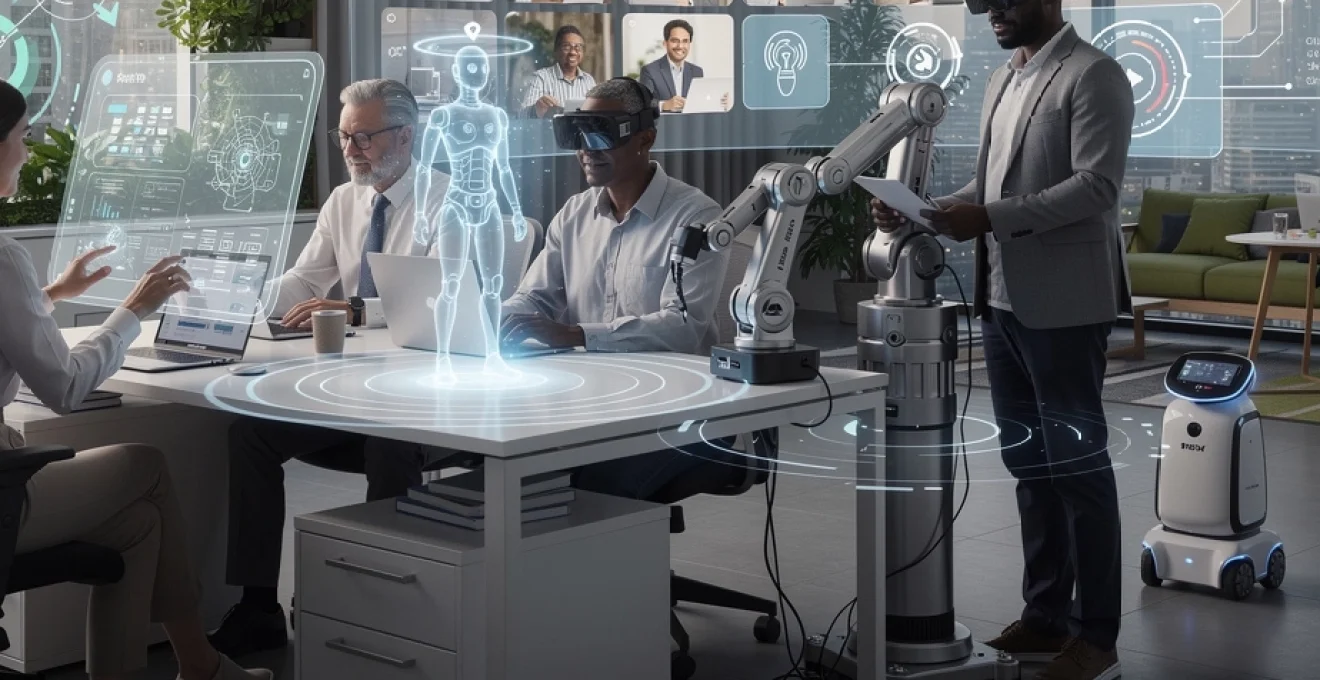
The workplace of 2030 will bear little resemblance to today’s professional environment. As technological advancement accelerates and global economic pressures reshape entire industries, organisations face unprecedented transformation in how they hire, manage, and develop their workforce. From artificial intelligence revolutionising decision-making processes to distributed teams collaborating across continents through immersive virtual platforms, the next decade promises radical changes that will redefine professional life for millions of workers worldwide.
This transformation extends far beyond simple technological upgrades. Fundamental shifts in employment structures, skill requirements, and organisational culture are creating new paradigms that challenge traditional notions of career development and workplace dynamics. Companies that recognise these changes early and adapt their strategies accordingly will gain significant competitive advantages in attracting top talent and maintaining operational efficiency.
Artificial intelligence and machine learning workforce integration
Artificial intelligence integration represents one of the most significant workplace transformations of the coming decade. Rather than simply replacing human workers, AI systems are increasingly designed to augment human capabilities, creating hybrid workflows that leverage both technological efficiency and human creativity. This collaborative approach requires organisations to fundamentally rethink job roles, performance metrics, and training programmes to maximise the potential of human-AI partnerships.
The implementation of AI across various business functions demands careful consideration of ethical implications and workforce development strategies. Companies must invest heavily in reskilling programmes to ensure employees can effectively collaborate with intelligent systems while maintaining critical thinking and creative problem-solving skills that remain uniquely human.
GPT-4 and large language model applications in professional services
Large language models are transforming professional services by automating complex document analysis, legal research, and client communication tasks. Law firms utilise these systems to review contracts and identify potential risks within minutes rather than hours, while consulting firms employ AI-powered tools to generate comprehensive market analysis reports and strategic recommendations. The technology’s ability to process vast amounts of information simultaneously enables professionals to focus on high-value strategic work rather than routine analytical tasks.
Professional services firms implementing large language models report significant productivity improvements, with some organisations achieving 40-60% reductions in time spent on research-intensive projects. However, the technology requires careful oversight to ensure accuracy and maintain ethical standards, particularly when dealing with sensitive client information or making recommendations that could significantly impact business decisions.
Robotic process automation implementation across industries
Robotic process automation continues expanding beyond traditional data entry applications to encompass complex business processes across manufacturing, finance, and healthcare sectors. Modern RPA systems can handle multi-step workflows involving decision trees, exception handling, and integration with multiple software platforms simultaneously. This evolution enables organisations to automate entire business processes rather than individual tasks, resulting in substantial operational efficiency gains.
The pharmaceutical industry exemplifies successful RPA implementation, with companies automating clinical trial data management, regulatory compliance monitoring, and drug safety reporting processes. These applications reduce human error rates by up to 90% while accelerating time-to-market for new treatments. Similar automation opportunities exist across virtually every industry, from retail inventory management to financial services risk assessment.
Human-ai collaborative frameworks in knowledge work
Successful human-AI collaboration requires carefully designed frameworks that clearly define roles, responsibilities, and decision-making authority between human workers and AI systems. These frameworks must address questions of accountability, quality control, and continuous learning to ensure optimal performance from both human and artificial intelligence components. Organisations developing effective collaborative frameworks often establish clear protocols for AI system training, performance monitoring, and human oversight requirements.
Knowledge workers increasingly function as AI system managers, interpreting algorithmic outputs, making strategic decisions based on AI recommendations, and providing contextual knowledge that improves system performance over time. This evolution requires new skill sets combining domain expertise with technical understanding of AI capabilities and limitations.
Algorithmic Decision-Making systems in recruitment and performance management
Algorithmic systems are revolutionising recruitment processes by analysing candidate profiles, predicting job performance, and identifying optimal matches between applicants and organisational culture. These systems can process thousands of applications simultaneously, identifying patterns and qualifications that human recruiters might overlook while reducing unconscious bias in initial screening processes. However, organisations must carefully monitor these systems to prevent algorithmic bias and ensure fair treatment of all candidates.
Performance management systems increasingly incorporate AI-powered analytics to track employee productivity, identify training needs, and
support more objective evaluations. By aggregating data from project outcomes, collaboration tools, and learning platforms, algorithmic performance systems can highlight top performers, flag burnout risks, and recommend personalised development plans. When implemented transparently and paired with clear communication, these tools help employees understand how their contributions are measured and what they can do to progress in their careers.
That said, businesses must balance data-driven insight with human judgment. Over-reliance on algorithmic decision-making can create a “black box” effect where employees feel reduced to metrics rather than seen as individuals. Leading organisations are therefore adopting hybrid performance models in which managers use AI-generated insights as inputs, not verdicts, combining quantitative indicators with qualitative feedback, coaching conversations, and employee self-assessments.
Remote work infrastructure and distributed team management
As remote and hybrid models become entrenched, the next decade of work will be defined by how effectively organisations support distributed teams. Remote work infrastructure is no longer just about video calls and email; it encompasses immersive collaboration tools, robust security frameworks, and management practices optimised for asynchronous communication. Companies that treat remote work as a strategic capability rather than a stopgap solution will unlock access to global talent and increased resilience.
However, building a sustainable distributed workforce model requires deliberate investment in technology, culture, and governance. Leaders must rethink how trust is built, how performance is measured, and how teams maintain cohesion when colleagues rarely share the same physical space. The organisations that succeed will be those that design their operating systems—processes, tools, and norms—around a reality where “office” is just one of many possible work environments.
Metaverse workspaces and virtual reality collaboration platforms
Metaverse workspaces and virtual reality collaboration platforms are emerging as the next frontier in remote work infrastructure. Instead of flat screens and grid-style video calls, employees can enter persistent 3D environments where avatars interact, brainstorm on virtual whiteboards, and prototype products in shared digital spaces. For tasks that rely on spatial awareness, such as design, engineering, or training simulations, these virtual workplaces can approximate the feel of being physically co-located.
Early adopters are already using VR for onboarding, leadership development, and complex technical training, reporting higher engagement and better knowledge retention compared to traditional e-learning. Over the next decade, as hardware becomes lighter and more affordable, we can expect virtual collaboration platforms to move from experimental pilots to mainstream usage, especially in global organisations. The key challenge will be ensuring accessibility, preventing “metaverse fatigue,” and integrating these environments smoothly with existing enterprise systems rather than treating them as isolated novelty tools.
Asynchronous communication protocols and global time zone coordination
When teams are distributed across multiple time zones, synchronous meetings quickly become a bottleneck. Asynchronous communication protocols—clear guidelines on how information is shared, documented, and responded to over time—will therefore be critical in the future of work. Rather than defaulting to real-time conversations, high-performing distributed teams rely on structured written updates, recorded video briefings, and well-organised knowledge repositories.
Practical strategies include “follow-the-sun” workflows, rotating meeting times to share inconvenience, and using shared documents as the primary space for decision-making instead of email threads. By designing work to move forward even when some team members are offline, organisations reduce delays and minimise burnout associated with odd-hour meetings. In effect, asynchronous communication turns global time zone differences from a coordination challenge into a productivity advantage.
Cloud-based project management systems and digital workflow automation
Cloud-based project management systems now sit at the heart of distributed team coordination. Tools that combine task tracking, document collaboration, and workflow automation enable teams to maintain visibility over progress regardless of location. When integrated with communication platforms and customer relationship management systems, these tools create a single source of truth for projects and processes, reducing duplication and misalignment.
Digital workflow automation adds another layer of efficiency by routing approvals, triggering notifications, and updating dashboards without manual intervention. For example, a sales proposal might automatically move through legal review, pricing approval, and client delivery, with each stakeholder notified at the right moment. Over the next decade, we can expect these systems to become increasingly intelligent, using AI to predict bottlenecks, recommend task assignments, and adjust timelines based on changing priorities.
Cybersecurity frameworks for distributed workforce protection
As work becomes more distributed and cloud-dependent, cybersecurity moves from an IT concern to a core business risk. Remote access, personal devices, and home networks all expand the potential attack surface, making traditional perimeter-based security models obsolete. In their place, organisations are adopting zero-trust architectures that verify every access request, regardless of location, device, or user role.
Future-ready cybersecurity frameworks combine multi-factor authentication, endpoint protection, encrypted communication, and continuous monitoring to protect sensitive data across a distributed workforce. Yet technology alone is not enough. Employees must be trained to recognise phishing attempts, manage passwords responsibly, and follow secure data-handling practices. In many ways, cybersecurity in the next decade will be as much about culture and behavioural design as it is about firewalls and encryption protocols.
Skills-based economy and continuous learning ecosystems
The next decade will see a decisive shift from credential-based hiring to a skills-based economy, where what you can do matters more than where you studied. As job roles evolve faster than traditional qualifications, organisations will increasingly rely on skills taxonomies, digital badges, and competency frameworks to match talent with opportunity. This trend is already visible in leading enterprises that map critical future skills and align recruitment, development, and internal mobility around them.
Continuous learning ecosystems will underpin this transformation. Rather than viewing training as a periodic event, companies will embed learning into the flow of work through micro-courses, just-in-time resources, and peer-led knowledge sharing. Employees will assemble “portfolio careers” composed of short learning sprints and project experiences, often straddling multiple disciplines. For organisations, the strategic question becomes: how do we build a learning culture robust enough to keep pace with technological change while still supporting day-to-day performance?
Practically, this means investing in learning experience platforms that aggregate content from multiple providers, track skills acquisition, and recommend personalised learning paths. It also means rewarding learning behaviours—such as mentoring, teaching, and experimentation—as much as traditional performance metrics. If we think of the future workforce as a constantly updating operating system, then continuous learning is the automatic update mechanism that keeps skills compatible with emerging roles and technologies.
Gig economy expansion and platform capitalism evolution
By 2030, the gig economy is likely to extend far beyond ride-hailing and food delivery into high-skill domains such as software development, marketing, data science, and even executive leadership. Platform capitalism—business models built around digital marketplaces that match supply and demand for labour—will continue evolving, offering both unprecedented flexibility and complex regulatory challenges. Professionals will increasingly blend traditional employment with freelance contracts, side projects, and short-term assignments across multiple platforms.
This expansion brings clear advantages for organisations seeking specialised skills on demand and for workers who value autonomy and variety. Yet it also raises critical questions around income stability, benefits, and worker protections. How do we ensure that flexible work does not translate into permanent precarity? Policymakers and platform operators will need to collaborate on new social safety nets, portable benefits, and transparent rating systems that protect both clients and workers.
Forward-thinking companies are already experimenting with hybrid talent models that integrate gig workers into core teams through long-term partnerships, shared tools, and clear communication channels. Rather than seeing the gig workforce as an external resource, they treat it as an extended talent ecosystem. In the next decade, mastering this ecosystem—knowing when to build, buy, or borrow skills—will be a defining capability for organisations competing in fast-moving markets.
Sustainable business models and green technology adoption
Sustainability will move from a branding initiative to a central pillar of business strategy over the coming decade. Investors, regulators, and employees are all increasing pressure on organisations to demonstrate measurable progress on environmental, social, and governance (ESG) goals. As a result, sustainable business models and green technology adoption will directly shape how and where work is done, from office design and commuting patterns to supply chain decisions and data centre locations.
For many companies, the journey to a low-carbon, resource-efficient operating model will require new roles, new skills, and new measurement tools. Sustainability officers, climate risk analysts, and green operations specialists will collaborate with finance, HR, and technology teams to embed environmental considerations into everyday decisions. In this environment, the ability to translate sustainability goals into concrete operational changes will become a valuable career asset across functions.
Carbon footprint tracking software and environmental impact measurement
Carbon footprint tracking software is becoming a standard component of corporate tech stacks as organisations seek to quantify and reduce their environmental impact. These tools aggregate data from energy use, travel, supply chains, and product lifecycles to provide a near real-time view of emissions. With more stringent disclosure regulations on the horizon in many regions, accurate and auditable carbon accounting will be essential for maintaining investor confidence and regulatory compliance.
Beyond compliance, detailed environmental impact measurement enables more informed strategic decisions. For example, companies can compare the emissions profile of remote work versus office-based models, or assess the carbon cost of different suppliers and logistics routes. Over time, we can expect carbon metrics to influence everything from procurement policies to performance targets, making environmental literacy an important competency for managers at all levels.
Circular economy principles in supply chain management
Circular economy principles—designing products and processes to minimise waste and maximise reuse—are reshaping supply chain management. Instead of linear “take-make-dispose” models, organisations are exploring closed-loop systems in which materials are recovered, refurbished, or recycled at the end of their useful life. This shift requires rethinking product design, packaging, reverse logistics, and after-sales services.
In practical terms, circular supply chains create new types of work, from remanufacturing and repair operations to materials innovation and lifecycle analysis. They also demand closer collaboration between procurement, operations, and sustainability teams to balance cost, resilience, and environmental performance. As resource constraints and regulatory pressures intensify, companies that embed circular economy thinking into their supply chains will not only reduce environmental impact but also enhance long-term competitiveness and risk management.
Renewable energy integration in corporate infrastructure
Renewable energy integration is rapidly becoming a board-level priority as organisations aim to decarbonise their operations and hedge against volatile fossil fuel prices. Corporate power purchase agreements, on-site solar installations, and investments in energy storage solutions are now common strategies for reducing scope 2 emissions. For distributed workforces, this may also extend to incentivising employees to use green energy at home or providing support for energy-efficient home office setups.
The technical and strategic complexity of renewable integration is creating demand for specialists who can align energy procurement with sustainability targets, financial constraints, and operational needs. Data centres, manufacturing plants, and large office campuses are being redesigned with energy efficiency and renewable compatibility in mind. Over the next decade, energy-aware decision-making—once confined to facilities management—will become a mainstream leadership skill as every major project is evaluated through both a financial and environmental lens.
Workforce demographics and generational technology adoption
Demographic shifts will profoundly influence how technology is adopted and used in the workplace. By 2030, many organisations will employ five generations side by side, from late-career Baby Boomers to Generation Alpha entering entry-level roles. Each cohort brings different expectations around communication, career progression, work-life balance, and technology usage. Managing these differences thoughtfully will be crucial to maintaining engagement and cohesion.
Younger generations tend to embrace new tools and platforms quickly, often acting as informal “digital accelerators” within teams. Older workers, meanwhile, contribute deep institutional knowledge and industry insight but may require more structured support to adapt to emerging technologies. Successful organisations will design onboarding, training, and change management programmes that cater to diverse learning styles and comfort levels with technology.
Rather than framing generational differences as obstacles, forward-looking leaders treat them as a source of strength. Reverse mentoring programmes, cross-generational project teams, and inclusive technology rollouts help bridge gaps and share expertise in both directions. In the next decade of work, the most resilient organisations will be those that combine the adaptability and digital fluency of younger employees with the experience and strategic perspective of their more tenured colleagues, creating truly multi-generational, technology-enabled workforces.